
Views: 0 Author: Site Editor Publish Time: 2026-08-06 Origin: Site


Flexible seating replaces traditional rows of fixed desks with a variety of seating and surface options that students can choose based on the activity and their learning preferences. The approach supports collaborative learning, differentiated instruction, and student autonomy.
Research from the University of Minnesota's College of Education (2024) found that students in flexible seating classrooms showed 23% higher on-task behavior compared to those in traditional desk arrangements, with the most significant improvements among kinesthetic learners and students with attention challenges.


Traditional classroom desks force students into static postures for extended periods. The EN 1729 standard (European Standard for Educational Furniture) defines ergonomic dimensions that support healthy posture:
Student Age | Seat Height (mm) | Desk Height (mm) | Backrest Height (mm) | Seat Depth (mm) |
3-4 years (preschool) | 260 | 460 | 240 | 290 |
5-6 years (kindergarten) | 290 | 520 | 260 | 310 |
7-9 years (primary) | 330 | 580 | 300 | 340 |
10-11 years (junior) | 380 | 640 | 340 | 380 |
12-14 years (middle) | 430 | 700 | 380 | 420 |
15+ years (secondary/adult) | 460 | 760 | 420 | 440 |
A 2024 study published in the Journal of Learning Environments measured brain activity in students using different seating types:
Seating Type | Movement Allowed | Engagement Score | Disruption Frequency |
Fixed desk + chair | Minimal | 62/100 | High |
Wobble stool | Active balance | 81/100 | Low |
Standing desk | Position change | 78/100 | Low |
Floor cushion | Postural freedom | 74/100 | Medium |
Collaborative table + chair | Group interaction | 85/100 | Very Low |
Furniture Type | Purpose | Hongye Model | Key Features | Standard Quantity |
Collaborative tables | Group work, projects | HY-EDU-CT series | Trapezoid/triangular tops, groupable | 6-8 per classroom |
Individual study desks | Independent work | HY-EDU-ID series | Lightweight, mobile, stackable | 20-25 per classroom |
Wobble stools | Active seating | HY-EDU-WS series | Non-slip base, 4 height options | 8-12 per classroom |
Standing desks | Posture variation | HY-EDU-SD series | Adjustable height, footrest bar | 4-6 per classroom |
Floor cushions | Floor-based learning | HY-EDU-FC series | Washable cover, 40mm foam | 8-10 per classroom |
Storage units | Organization | HY-EDU-SU series | Mobile, lockable, labeled bins | 4-6 per classroom |
Mobile whiteboards | Interactive surfaces | HY-EDU-WB series | Double-sided, magnetic, castored | 2-3 per classroom |
All Hongye educational furniture meets the following safety and environmental standards:
Standard | Scope | Requirement |
EN 1729 Parts 1 & 2 | Ergonomic dimensions and safety | Size, shape, stability, load |
BIFMA X5.1 | Seating durability | 100,000+ cycle testing |
GREENGUARD Gold | Indoor air quality | VOC emissions below 0.5 mg/m³ |
FSC Chain of Custody | Responsible timber | Certified sustainable forests |
CPSIA 2008 (US) | Children's product safety | Lead content below 100ppm |
EN 71-3 (EU) | Chemical migration limits | Heavy metals in surface coatings |
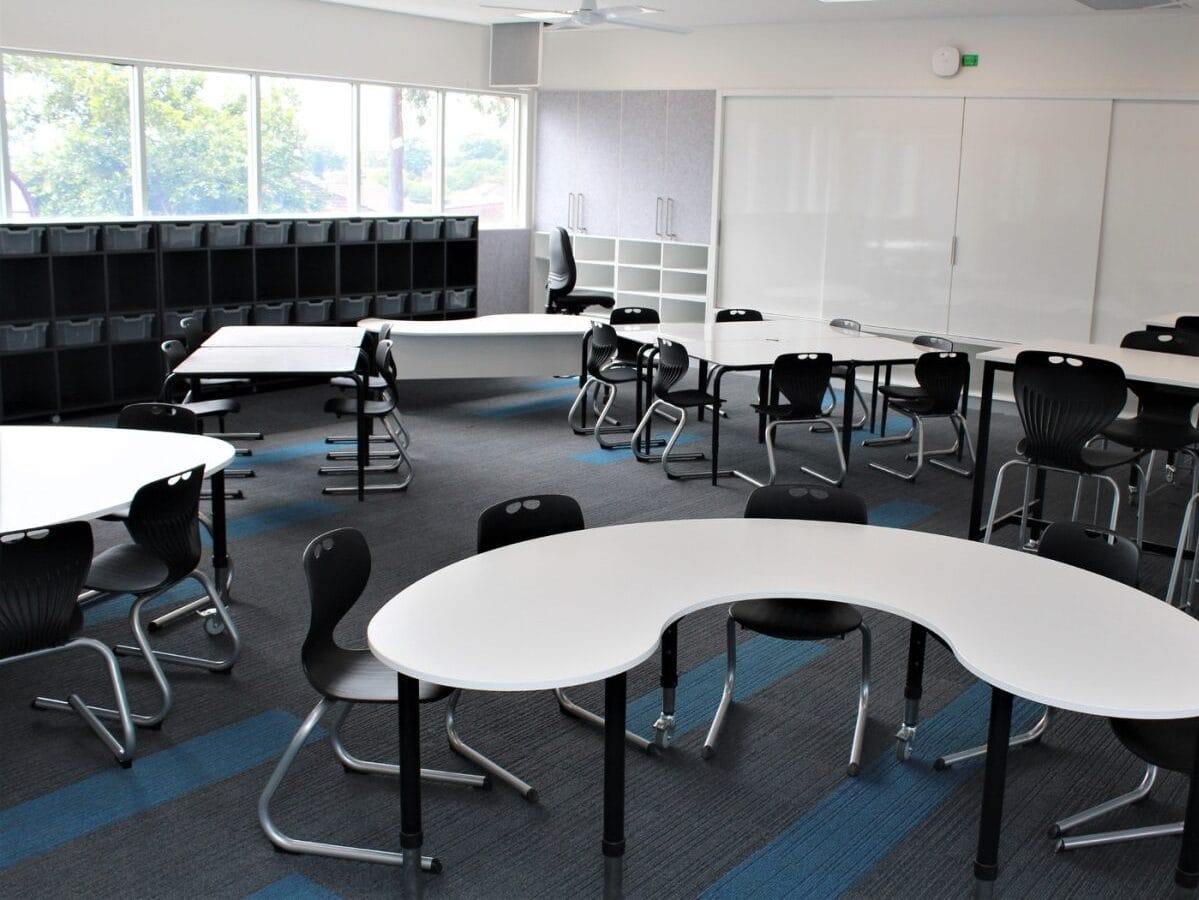
Arrange furniture in a horseshoe or paired rows facing the teacher. Mobile desks with castors allow this configuration in under 5 minutes.
Layout | Floor Space Needed | Setup Time | Student Capacity |
Horseshoe | 60-70 m² | 3-4 minutes | 24-30 |
Paired rows | 55-65 m² | 2-3 minutes | 28-32 |
Theater (standing) | 40-50 m² | 1-2 minutes | 30-36 |
Group tables into clusters of 4-6 students. Collaborative tables with triangular or trapezoid tops interlock to create circular group surfaces.
Spread individual desks and standing desks around the room perimeter, giving students choice of seating type and privacy level.
Clear the center of the room by stacking or rolling furniture to the perimeter. Mobile storage units with integrated seating double as audience benches.
Project Snapshot: In 2025, Hongye supplied flexible seating furniture for 14 classrooms at an international school in Dubai, UAE. The project included 350 collaborative tables, 280 wobble stools, 120 standing desks, and 56 mobile storage units. All furniture met EN 1729 and GREENGUARD Gold standards. The school reported a 28% improvement in student engagement scores and 19% reduction in behavioral disruptions within the first semester.


Budget Level | Furniture Package | Cost per Classroom (24 students) | Expected Lifespan |
Budget | Fixed desks + chairs (traditional) | $3,500-$5,500 | 8-10 years |
Mid-range | Hybrid (some flexible + some fixed) | $6,000-$9,000 | 8-10 years |
Full flexible | Complete flexible seating package | $8,500-$14,000 | 7-10 years |
Premium | Flexible + technology integrated | $12,000-$20,000 | 7-10 years |
While full flexible seating costs 2-2.5x more than traditional furniture upfront, the 5-year total cost of ownership is comparable because flexible furniture reduces reconfiguration costs and adapts to curriculum changes without replacement.
What is flexible seating in a classroom?
Flexible seating is a classroom design approach that replaces fixed rows of desks with multiple seating and surface options — collaborative tables, wobble stools, standing desks, floor cushions — that students can choose based on their learning activity and personal preferences. Research shows it improves engagement by 20-30% and reduces disruptive behavior by 15-22%.
What are the benefits of flexible seating for students?
Benefits include improved posture and physical comfort (EN 1729 ergonomic support), increased student autonomy and motivation, better collaboration skills through group-based configurations, and reduced behavioral disruptions. A 2024 University of Minnesota study found 23% higher on-task behavior in flexible seating classrooms.
What safety standards should classroom furniture meet?
Classroom furniture should meet EN 1729 (ergonomic dimensions and safety), BIFMA X5.1 (durability), GREENGUARD Gold (low VOC emissions), FSC (responsible timber), CPSIA 2008 (children's product safety in the US), and EN 71-3 (chemical safety in the EU). Hongye's educational furniture meets all of these standards.
How much does flexible classroom furniture cost?
A complete flexible seating package for a 24-student classroom costs $8,500-$14,000, including collaborative tables, wobble stools, standing desks, floor cushions, and storage units. While this is 2-2.5x the cost of traditional furniture, the 5-year total cost of ownership is comparable due to reduced reconfiguration and replacement expenses.
Can existing classrooms be converted to flexible seating?
Yes. Existing classrooms can be converted incrementally by replacing fixed desks with mobile alternatives over 1-3 budget cycles. Hongye offers phased implementation plans that prioritize high-impact items first (collaborative tables and wobble stools) and add standing desks and storage units in subsequent phases.


 English

