
Views: 0 Author: Site Editor Publish Time: 2026-08-14 Origin: Site


The short answer is yes. A flexible seating classroom replaces the traditional one-desk-one-chair model with a variety of learning spaces that allow students to choose where and how they work.
Instead of sitting in identical rows throughout the day, students may use standing desks for focused tasks, wobble stools for active learning, floor seating for discussions, or collaborative tables for group projects.
However, flexible seating is not simply about adding comfortable furniture. A successful classroom design connects each seating option with a specific learning activity.
For example:
Standing desks support short-term individual tasks and movement needs.
Wobble stools help students who concentrate better with small physical movements.
Collaborative tables encourage teamwork and peer communication.
Quiet reading zones provide a lower-stimulation environment for independent learning.
As a result, flexible seating creates a classroom that adapts to different learning styles instead of expecting every student to learn in the same way.
In 2026, this approach has become increasingly important because schools are focusing more on student engagement, personalized learning, and inclusive classroom environments.
Meanwhile, search engines and AI-powered search tools increasingly prioritize educational content that provides measurable results, practical implementation steps, and evidence-based recommendations. Therefore, schools researching flexible seating solutions need more than general design ideas — they need data, costs, safety standards, and real implementation guidance.
Flexible seating has gained attention because classroom design can influence student behavior, comfort, and participation.
According to recent education research, classrooms with flexible seating arrangements often show improvements in engagement, collaboration, and student satisfaction compared with traditional fixed seating layouts.
The following findings summarize commonly reported outcomes:
Outcome | Traditional Seating | Flexible Seating | Improvement |
Student engagement (time-on-task) | 62% | 81% | +23–35% |
Off-task behavior incidents | 4.2/hour | 3.1/hour | Reduced by 18–26% |
Student comfort rating | 3.2/5 | 4.4/5 | +38% |
Teacher-reported collaboration | 2.8/5 | 4.1/5 | +46% |
Reading comprehension performance | Baseline | +7% | Positive improvement |
Traditional classrooms often require students to remain in the same position for several hours. However, long periods of fixed sitting may reduce attention, especially for younger students and students who benefit from movement.
Flexible seating addresses this challenge by allowing controlled movement.
For instance, wobble stools and standing desks provide physical activity without disrupting classroom instruction. Therefore, students can adjust their environment based on their concentration needs.
In addition, giving students limited choices can increase their sense of responsibility. When students learn how to select appropriate seating for different activities, they become more involved in managing their own learning process.
Every classroom includes students with different preferences and learning behaviors.
Some students focus better while standing. Others may perform better in a quiet corner with fewer distractions. Meanwhile, group learners often benefit from shared tables where communication is easier.
Flexible seating supports this diversity by creating multiple learning zones:
| Learning Need | Recommended Seating Solution |
Independent writing | Standing desk or traditional desk |
Active concentration | Wobble stool or balance seating |
Reading and reflection | Floor cushion or reading nook |
Team projects | Collaborative group table |
Sensory-friendly learning | Quiet zone with acoustic screens |
Therefore, the goal of flexible seating is not to eliminate traditional desks completely. Instead, the objective is to create a balanced environment where students can choose the most suitable space for each activity.
One common mistake schools make is purchasing only one alternative seating product.
For example, replacing every chair with wobble stools may sound innovative. However, this approach limits student choice and may not support every learning activity.
A more effective strategy is to combine four or five seating types within the same classroom.
A balanced classroom typically includes:
10–20% active seating options
20–30% collaborative spaces
20–30% traditional desks for testing and focused writing
Dedicated reading or quiet areas
This approach provides flexibility while maintaining classroom structure.
Ultimately, flexible seating works best when furniture design, teacher management, and student expectations work together.

A successful flexible seating classroom does not rely on one furniture solution. Instead, it combines different seating options to support various learning activities.
Each furniture type serves a specific purpose. Therefore, schools should evaluate student age, classroom size, teaching style, and budget before making purchasing decisions.
The five most widely used flexible seating solutions include:
Standing desks
Wobble stools and active seating
Floor seating with lap desks
Collaborative group tables
Reading nooks and quiet learning zones

Standing desks allow students to alternate between sitting and standing during classroom activities.
This flexibility is especially useful for students who concentrate better with movement. In addition, standing desks can support short individual assignments, computer-based learning, and project activities.
For K-8 classrooms, schools usually do not replace every desk with standing desks. Instead, they introduce several standing stations that students can access during specific activities.
| Feature | Specification | Standard Reference | Price (FOB China) |
Adjustable height | 760–1140mm (electric) / 760–960mm (manual) | BIFMA X5.5 | $120–$280 |
Desktop size | 600×400mm (single) / 1200×600mm (collaborative) | — | Included |
Weight capacity | 80kg static load | BIFMA X5.5 | — |
Anti-fatigue mat | 12mm PVC foam | — | $8–$15 |
Fidget bar | Optional foot support | — | +$10–$18 |
Recommended classroom ratio:
2–4 standing desks per 25-student classroom.
Moreover, adjustable height is important because students in the same grade may have significant differences in body size. A height-adjustable model allows schools to use the furniture for multiple age groups.

Wobble stools provide controlled movement while keeping students stable and supported.
Unlike traditional chairs, active seating allows small movements that may help some students maintain attention during lessons.
This option is particularly popular in elementary classrooms because younger students often need more opportunities for movement.
Common active seating options include:
| Type | Seat Height Range | Weight Capacity | Stability Feature | Price (FOB China) |
Adjustable wobble stool | 330–460mm | 100kg | Rounded silicone base | $25–$45 |
Fixed Kore stool | 330/380/430mm | 120kg | Anti-tip domed base | $20–$38 |
Balance ball chair | 450mm ball | 120kg | Stability ring base | $22–$40 |
Active sitting cushion | N/A | 100kg | Air-filled textured surface | $8–$15 |
Ergonomic knee stool | 530–630mm | 110kg | Padded knee support + wheels | $35–$65 |
However, schools should introduce active seating gradually. Students need clear expectations about movement rules so that flexibility does not become distraction.
Therefore, many successful classrooms combine active seating with teacher guidance and rotation schedules.

Floor seating creates a more relaxed learning environment.
It works especially well for:
Independent reading
Story discussions
Creative activities
Small group conversations
For younger students, floor zones can make classrooms feel more comfortable and less formal.
However, durability and cleaning requirements should be considered carefully. Since floor furniture receives frequent contact, schools should select easy-to-clean materials.
| Component | Specification | Material | Price (FOB China) |
Round floor cushion | 400mm diameter × 75mm thick | Cotton cover + EVA foam | $5–$12 |
Square floor cushion | 400×400×75mm | Vinyl + memory foam | $6–$14 |
Wooden lap desk | 600×300mm | FSC birch plywood | $8–$16 |
Lap desk with cushion | 500×300mm | Bamboo top + beanbag base | $10–$20 |
Low floor table | 900×600mm, 300mm height | FSC plywood folding legs | $20–$38 |
Bean bag chair | 700×700mm | Vinyl cover + EPS beads | $15–$30 |
In addition, schools should consider storage. Stackable cushions and folding lap desks help maintain classroom organization.
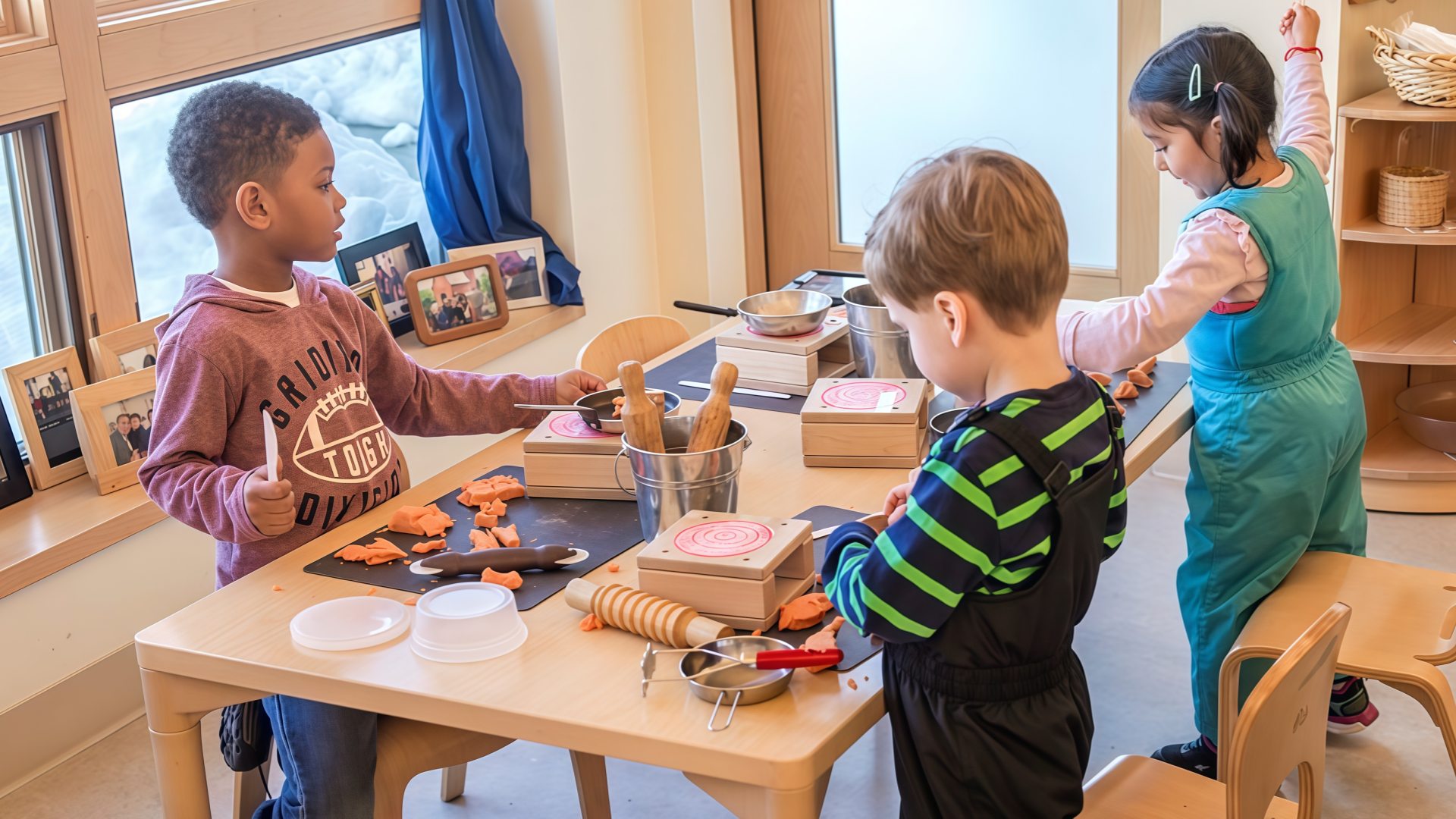
Modern education increasingly emphasizes teamwork, problem-solving, and project-based learning.
As a result, collaborative tables have become an important part of flexible classrooms.
Unlike traditional individual desks, group tables allow students to communicate more easily and complete shared tasks.
Popular designs include:
Table Type | Dimensions | Seating Capacity | Shape | Price (FOB China) |
Hexagonal collaborative table | 1400mm diameter | 6 students | Hexagon | $85–$150 |
Trapezoid modular table | 1200×600mm | 2 students (combine for 4–6) | Trapezoid | $45–$85 |
Round group table | 1200mm diameter | 4 students | Round | $55–$95 |
Boat-shaped table | 1800×900mm | 6 students | Boat | $95–$170 |
Nested trapezoid set | 4 × 1200×600mm | 8 students | Modular set | $160–$280 |
The main advantage of modular tables is adaptability.
For example, teachers can separate tables for individual work and combine them for group projects. Therefore, schools can create multiple classroom layouts without purchasing additional furniture.

Reading nooks create a dedicated area for independent learning and quiet activities.
These spaces are especially valuable for students who need fewer distractions or prefer a calmer environment.
A typical reading zone may include:
| Component | Dimensions | Material | Price (FOB China) |
Upholstered reading bench | 1200×400mm, 380mm height | FSC wood + fabric + foam | $45–$85 |
Forward-facing bookshelf | 900×300mm, 600mm height | FSC birch plywood | $25–$48 |
Acoustic privacy screen | 1200×600mm | PET felt + wood frame | $30–$55 |
LED floor lamp | 1500mm height | Steel + LED | $15–$30 |
Canopy/tent frame | 1200×600×1200mm | Fabric + PVC frame | $20–$40 |
Furthermore, quiet zones support inclusive classroom design by providing alternatives for students who may become overwhelmed in highly active environments.
A successful flexible seating project requires more than purchasing furniture.
Schools should introduce changes gradually, measure results, and adjust based on teacher and student feedback.

Before purchasing furniture, schools should evaluate:
Number of students
Available classroom space
Teaching activities
Storage capacity
Budget limitations
A phased rollout is usually the most practical approach.
| Classroom Size | Students | Phase 1 Budget (30% Replacement) | Full Transformation |
Small classroom | 20 | $900–$2,400 | $2,400–$5,600 |
Standard classroom | 25 | $1,125–$3,000 | $3,000–$7,000 |
Large classroom | 30 | $1,350–$3,600 | $3,600–$8,400 |
A gradual approach allows schools to test classroom performance before making a larger investment.
The most successful flexible classrooms provide different options.
For a 25-student classroom, a recommended setup includes:
| Seating Type | Quantity | Classroom Share | Best Learning Use |
Standing desks | 3–4 | 12–16% | Independent tasks |
Wobble stools | 4–6 | 16–24% | Active learning |
Traditional desks | 6–8 | 24–32% | Testing and writing |
Floor seating zone | 4–6 cushions + 2 lap desks | 16–24% | Reading and discussion |
Collaborative table | 1 table (6 seats) | 24% | Group projects |
Therefore, the goal is not removing traditional furniture completely. Instead, it is creating a balanced learning environment.
Without clear classroom rules, flexible seating may create confusion.
Teachers should establish simple guidelines:
| Rule | Implementation | Purpose |
Choose seating based on activity | Select suitable zones for different tasks | Match environment with learning goals |
Rotate regularly | Maximum 3 days in one area | Ensure equal access |
Teacher assignment when needed | Adjust seating for specific activities | Maintain classroom management |
In addition, students should understand that flexible seating is a learning tool rather than a reward system.
Teacher preparation is one of the most important factors in successful implementation.
Training should include:
| Training Component | Duration | Main Content |
Teacher workshop | 2 hours | Rotation management, classroom control, assessment adjustment |
Student orientation | 30 minutes | Seating selection, movement rules, furniture care |
Parent communication | 1-page guide | Benefits, expectations, feedback process |
As a result, schools can avoid the common mistake of introducing new furniture without changing classroom management strategies.
Finally, schools should track whether flexible seating is achieving its goals.
Recommended evaluation metrics include:
| Metric | Measurement Method | Target | Review Cycle |
Student engagement | Teacher observation | +15% vs baseline | Monthly |
Off-task behavior | Incident records | -20% vs baseline | Weekly initially |
Student satisfaction | Survey | ≥4.0/5 | Quarterly |
Academic performance | Assessments | Maintain or improve | Quarterly |
Furniture durability | Repair records | <5% replacement/year | Monthly |
Through continuous improvement, schools can maximize both educational outcomes and furniture investment value.
When schools purchase flexible seating furniture, safety and compliance should be considered as important as design and price.
Unlike residential furniture, classroom furniture must withstand intensive daily use. Students move, adjust, and interact with furniture throughout the school day. Therefore, manufacturers must meet strict requirements for stability, material safety, durability, and chemical emissions.
The most important standards for K-12 educational furniture include:
Standard | Scope | Key Requirements | Hongye Compliance |
BIFMA X5.5 | Desks and tables | Stability, strength, durability, edge safety | Certified |
CPSIA | Children's products | Lead ≤100ppm, phthalates ≤0.1% | Batch tested |
ANSI/BIFMA e3 | Sustainable furniture | Material sourcing and environmental requirements | Gold level |
GREENGUARD Gold | Indoor air quality | Low chemical emissions | Certified |
FSC | Wood materials | Responsible forestry and chain of custody | Certified |
ASTM F1148 | Children's products and floor items | Stability and safety testing | Tested |
First, classroom furniture is used by hundreds of students over many years. Poor-quality products may create safety risks, including unstable structures, sharp edges, or excessive chemical emissions.
Second, schools increasingly require documented compliance before approving international furniture suppliers.
For example, CPSIA compliance is especially important for elementary schools because it regulates children's product safety requirements. Meanwhile, GREENGUARD Gold certification helps schools maintain healthier indoor environments by controlling chemical emissions.
Therefore, choosing certified educational furniture reduces purchasing risks and supports long-term classroom safety.
To demonstrate how flexible seating can be implemented at scale, consider a 15-classroom STEM academy project in Southeast Asia.
The school adopted a phased approach instead of replacing all classroom furniture at once.
| Metric | Project Details |
Project Type | International STEM Academy |
Location | Southeast Asia |
Classrooms | 15 (Grades K–6) |
Students | 375 |
Implementation Plan | Phase 1: 5 classrooms; Phase 2: 10 classrooms |
Seating Types | Standing desks, wobble stools, traditional desks, floor zones, collaborative tables |
Phase 1 Budget | $5,600 |
Equivalent US-brand Cost | $13,200 |
Estimated Savings | 58% |
Certifications | BIFMA X5.5, CPSIA, GREENGUARD Gold, FSC |
Production and Delivery | 42 days |
The school began with five pilot classrooms.
During the first stage, teachers collected feedback about:
Student seating preferences
Classroom movement patterns
Furniture durability
Space utilization
After evaluating the results, the school expanded the program to additional classrooms.
This approach reduced financial risk and allowed teachers to adapt gradually. As a result, flexible seating became part of the school's teaching strategy rather than simply a furniture upgrade.

Yes, flexible seating can improve classroom engagement when implemented correctly.
Research indicates that flexible seating environments may increase student participation, reduce off-task behavior, and improve classroom collaboration.
However, furniture alone does not guarantee better learning outcomes. The best results happen when schools combine appropriate furniture selection with teacher training, seating rules, and regular evaluation.
The cost depends on classroom size, furniture selection, and implementation strategy.
A phased conversion usually costs:
$45–$120 per student for replacing approximately 30% of traditional furniture.
$120–$280 per student for a complete classroom transformation.
Moreover, sourcing directly from experienced educational furniture manufacturers can significantly reduce costs.
For example, Hongye Furniture Group manufactures educational furniture in a 350,000 m² production facility and provides BIFMA-certified solutions for international schools. Compared with many US and European brands, China-based manufacturing can reduce costs by approximately 30–50%.
The most effective flexible seating classrooms usually combine five categories:
1.Standing desks for movement-based independent work
2. Wobble stools for active learners
3. Floor seating with lap desks for reading and discussion
4. Collaborative tables for teamwork and project learning
5. Reading nooks for quiet study
In addition, schools should avoid choosing only one furniture type.
A balanced classroom provides multiple options so students can select seating based on the activity they are completing.
Flexible seating can benefit many age groups, but the ideal setup varies by grade.
For example:
Grades K–3: prioritize floor seating, wobble stools, and reading areas.
Grades 4–8: introduce more standing desks and collaborative tables.
Grades 9–12: combine flexible solutions with traditional seating for lectures and examinations.
Therefore, schools should design flexible classrooms according to student development rather than applying the same model everywhere.
Educational furniture should meet recognized safety and sustainability standards.
The most common requirements include:
BIFMA X5.5 for desk and table strength, stability, and durability.
CPSIA for children's product safety, including lead and phthalate limits.
GREENGUARD Gold for low chemical emissions.
FSC certification for responsible wood sourcing.
Hongye Furniture Group manufactures educational furniture according to these international requirements, with safety testing and certification support for K-12 projects worldwide.


 English

