
Views: 0 Author: Site Editor Publish Time: 2026-05-12 Origin: Site


Well‑structured procurement documents and specifications are the backbone of any successful school furniture project. A clear educational furniture procurement checklist helps institutions secure safe, durable, and pedagogically appropriate solutions instead of simply defaulting to the lowest upfront price. When specifications are vague or incomplete, the result is often inconsistent quality, missed safety requirements, and furniture that does not support the teaching and learning methods your campus is working hard to implement.

This article is written for school and university procurement teams, project managers, and consultants who prepare school furniture RFQ documents and tender packages. It provides a practical, step‑by‑step framework for building a robust education furniture tender checklist, so that every requirement is documented, traceable, and easy for bidders to understand. Used correctly, this school furniture specification checklist will reduce clarification rounds, minimize change orders, and significantly lower the risk of non‑compliant deliveries.
A complete procurement file for educational furniture has three main layers. First, you need clear project framing: a documented needs assessment, space inventory, and scope definition that explains what you are trying to achieve and for whom. Second, you require the core RFQ and tender documents themselves, including room data sheets, furniture schedules, drawings, and detailed technical specifications that suppliers can price and verify.
Finally, your educational furniture procurement checklist must also include review, approval, and risk‑control mechanisms. These ensure that what goes out to the market aligns with safety standards, institutional policies, and long‑term value objectives rather than short‑term savings. Throughout this article, we will build out each of these components, turning the high‑level school furniture specification checklist into actionable documents that can be implemented on real projects.
Before you start writing specifications or issuing an RFQ, you need a clear understanding of the project context. This section explains how to document the overall project scope so that your educational furniture procurement checklist is anchored in real teaching, capacity, and timeline needs. When the front‑end work is done properly, the rest of the school furniture RFQ documents become significantly easier to assemble and much more consistent.

The first step is to create a space inventory that lists all areas requiring furniture, along with their functions and target capacities. At a minimum, this inventory should include room identifiers, room types (e.g., general classroom, science lab, library, seminar room, dormitory), and maximum student or occupant numbers. For larger campuses, this might break down into hundreds of spaces across multiple buildings, so using a standardized template is essential for maintaining control.
Link each space to specific user groups and age or body‑size ranges. For example, a primary classroom may be designed for students aged 6–10, while a university lab might be used by adults and postgraduates. This information feeds directly into the school furniture specification checklist for desk heights, chair dimensions, and ergonomic requirements. It also supports accessibility planning, such as the number of wheelchair‑accessible desks required per floor or building.
A complete space inventory is critical for accurate quantity take‑offs, phasing, and budget planning. If room functions or capacities change late in the process, unit prices might remain stable but total cost can increase by 10–20% simply due to revised quantities. Documenting these assumptions upfront and updating them systematically keeps your education furniture tender checklist aligned with the project reality.
Next, capture the teaching models and learning environments that your furniture needs to support. Many institutions are shifting from traditional row‑based classrooms to active learning spaces, flexible collaboration zones, and hybrid teaching configurations. These choices directly affect the type and performance of the furniture you specify.
For example, a traditional lecture room may only require fixed‑height student desks and stackable chairs, whereas an active learning classroom might need mobile tables on casters, height‑adjustable seating, and integrated power for laptops. When you record these pedagogical intentions in your educational furniture procurement checklist, you enable suppliers to propose more appropriate solutions and avoid misinterpretations.
Documenting pedagogy early also prevents conflicts between educators, designers, and purchasing teams later. Teachers and academic leadership can sign off on the intended teaching modes per room type before the tender goes out. This reduces the likelihood of late design changes that can postpone deliveries or trigger costly contract variations.


STEM Classrooms Furniture Ergonomic Student Desk And Chair
Finally, you must align your educational furniture procurement checklist with realistic timelines and budget expectations. A typical project might include design and specification, tendering, manufacturing, shipping, installation, and commissioning, often spread over 9–18 months for larger campuses. Within that period, key milestones such as term starts, exams, and building handovers must be respected.
Document planned dates for tender release, bid evaluation, award, sample approval, and last possible delivery to site. In many cases, furniture installation needs to be completed in a 4–8 week window between terms. If manufacturing lead times for core items are typically 8–12 weeks plus 4–6 weeks for shipping and customs, your RFQ must be issued early enough to avoid schedule compression. Including these timing constraints in your school furniture RFQ documents gives bidders a clear basis for planning production.
Budget envelopes should be linked to durability and lifecycle expectations rather than just initial cost. For example, paying 10–15% more per unit for products with an expected lifespan of 10 years instead of 5 can reduce long‑term replacement spend by 20–30%. Capturing these principles in the front‑end scope description ensures that your education furniture tender checklist reflects total value, not just short‑term price.
Once the project is properly framed, you can move on to the core RFQ and tender documentation. This section defines the key documents that together form a complete and coherent procurement package for educational furniture. When combined, these documents allow suppliers to understand what is required, how it will be used, and how their proposals will be evaluated.
The furniture brief is a high‑level document that sets the tone for the entire procurement. It should summarize project objectives, target user groups, design intent, and general quality expectations. This is also an ideal place to reiterate any institutional priorities, such as sustainability targets, inclusivity, or universal design principles.
From there, translate the brief into performance‑oriented requirements rather than prescribing a single model or brand. For example, instead of specifying one fixed chair model, the educational furniture procurement checklist could state that classroom seating must support a static load of at least 120 kg, meet relevant ergonomic standards, and provide stackability for efficient storage. This approach allows suppliers to propose multiple compliant solutions and can reveal opportunities for better value or innovation.
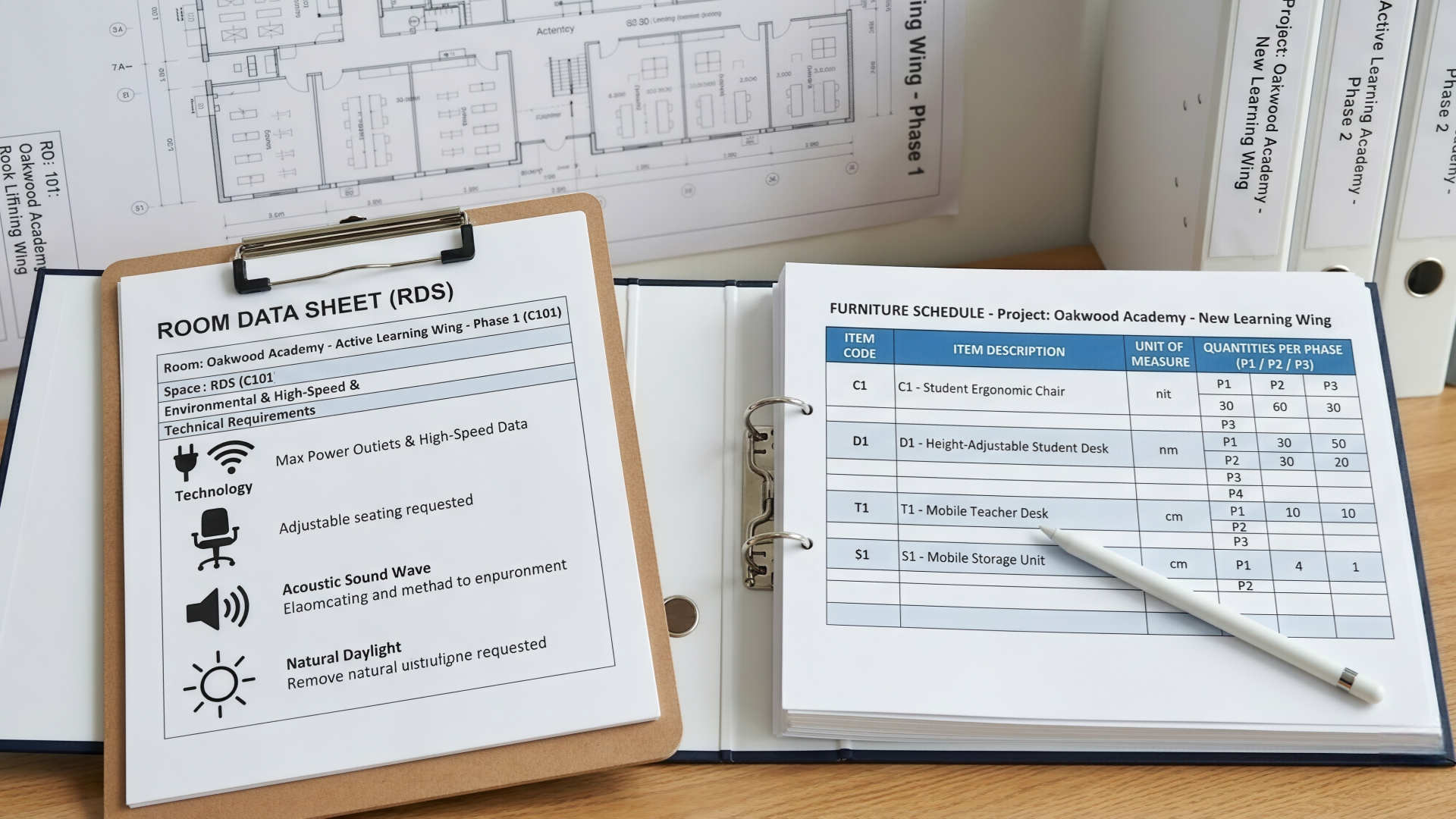
Room data sheets (RDS) and furniture schedules form the detailed core of your school furniture RFQ documents. An RDS links each space in your inventory to its functional requirements, special constraints, and key performance expectations. It may document items such as AV equipment, storage needs, or specific accessibility requirements, which then influence the furniture specification.
Furniture schedules list each item type required, the quantity per room, total project quantities, and any options or alternates. For example, a schedule may show that Classroom Type A requires 30 student chairs, 30 student desks, 1 teacher’s desk, and 1 mobile storage unit. Across a campus with dozens of similar rooms, this can add up to thousands of units. A well‑structured schedule helps both buyers and bidders to validate quantities and simplifies later change management when room counts are adjusted.
A simple table structure like the one below can be used inside your education furniture tender checklist template to summarize key schedule fields:
| Parameter / Option | Description |
Room type | Standardized name and function of the room |
Furniture item code | Unique reference for each furniture type |
Quantity per room | Number of units required in a single room |
Total quantity (all rooms) | Project‑wide quantity of each furniture item |
Options/alternates allowed | Indication of acceptable alternative solutions |
This format makes it easy to spot inconsistencies and ensures that multiple bidders are working from the same baseline numbers.
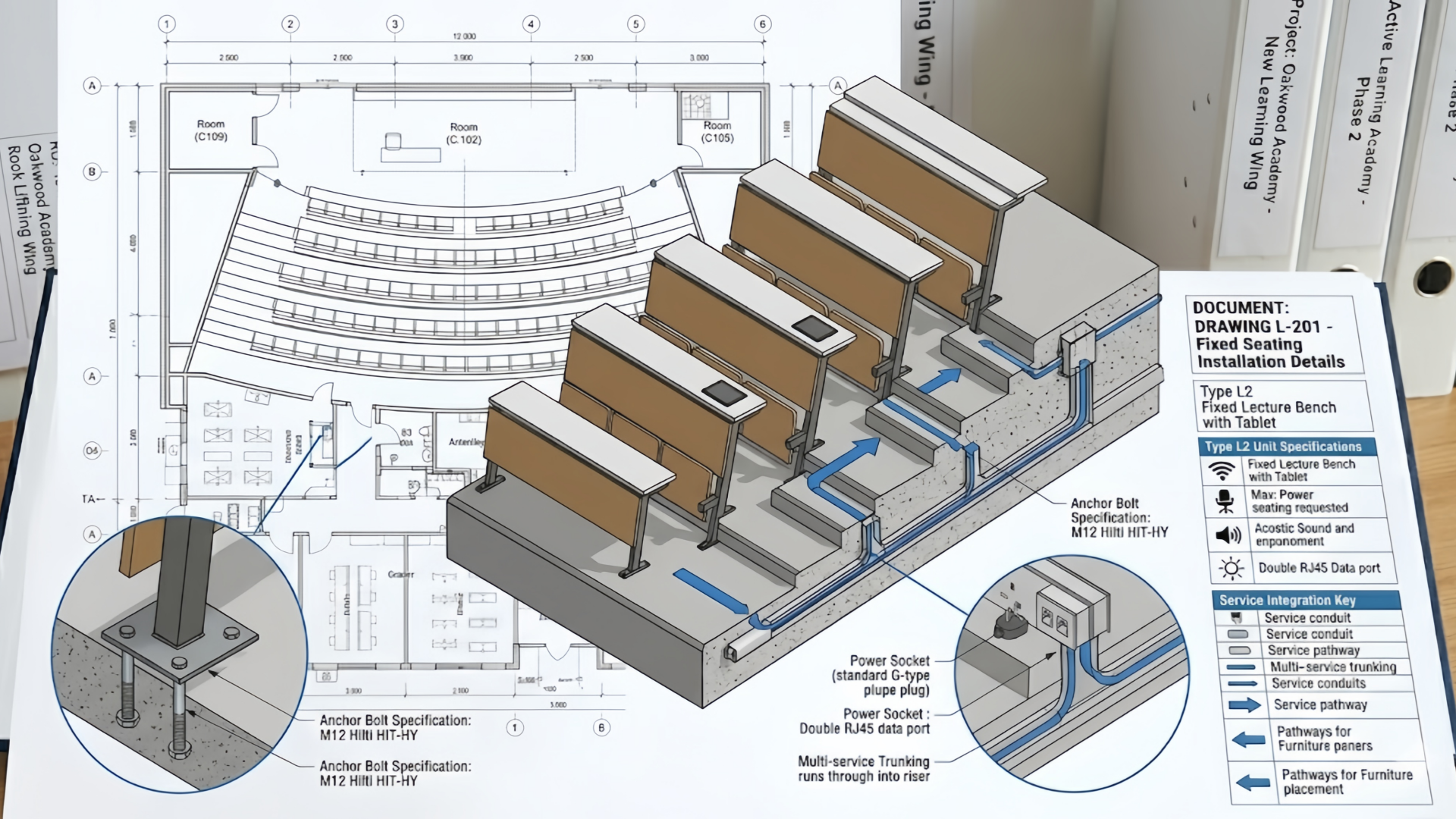
Drawings and layouts provide the spatial context that complements your written specifications. At a minimum, RFQ packages should include floor plans showing furniture layout, circulation paths, and clearances around key areas like doors and escape routes. For specialized spaces, such as tiered lecture theatres or laboratories, elevations and sections are often necessary to clarify relationships between furniture and building elements.
Installation details are sometimes overlooked in school furniture RFQ documents but are crucial for complex items like fixed seating, lab benches with services, or wall‑mounted storage. Your educational furniture procurement checklist should indicate when anchoring details, interface points for power or data, and structural coordination are required. Including this information from the start minimises ambiguous pricing and reduces the risk that bidders exclude important works.
This section is the heart of a technical education furniture tender checklist. It provides a practical, itemized set of specification elements that should be addressed for seating, desks, tables, storage, and other educational furniture. The aim is to ensure that safety, ergonomics, materials, and finishes are clearly defined, measurable, and verifiable.
A robust school furniture specification checklist in this area helps procurement teams compare proposals objectively and makes it easier to reject non‑compliant bids. It also gives consultants a structured framework for incorporating local regulations and institutional standards without rewriting every RFQ from scratch.

Product definitions and scope
Define each furniture family with clear intended use, user group, and typical locations. For instance, a “Classroom Chair Type C1” could be specified for primary students in general classrooms, while a “Lecture Seat Type L2” is targeted at higher‑education lecture theatres. Clear definitions avoid mix‑ups between products designed for different loads and use patterns.
Distinguish between base items and optional accessories to simplify comparison. For example, base items might include the core chair and desk, while accessories could be book hooks, linking devices, tablet arms, or integrated power modules. When accessories are clearly listed, suppliers can price them separately and buyers can decide which are essential.
Dimensions, ergonomics, and adjustability
Set out dimensional ranges and ergonomic criteria that match your user groups. Typical seat heights may range from 300–460 mm depending on age, and writing surface heights often sit between 580–760 mm. Including these values in your educational furniture procurement checklist ensures that all proposals are designed for the intended users, not just generic adult dimensions.
Indicate where adjustability or mobility is required. For example, active learning classrooms may require flip‑top tables with lockable casters, while standard lecture theatres may rely on fixed seats with fold‑away writing tablets. Stating these needs clearly up front avoids receiving a mix of incompatible solutions.
Structural performance and durability
Specify minimum load capacities and stability requirements for each furniture type. A common baseline is a static load of 120 kg on classroom chairs and higher requirements for public seating. Additionally, you can call for test performance such as 80,000–100,000 seat fatigue cycles for heavily used spaces.
Reference relevant national or international testing standards and state that independent test reports must be provided. This may include EN standards for school furniture, BIFMA standards for seating, or national safety norms. Including this in the school furniture specification checklist provides a straightforward way to filter out suppliers who cannot demonstrate compliance.
Materials, finishes, and fire performance
Define acceptable materials for frames (e.g., steel, aluminium), tops (e.g., high‑pressure laminate, solid wood, compact laminate), panels, upholstery, and foams. For each, specify minimum quality levels, thickness ranges, and any environmental requirements such as FSC‑certified wood or recycled content.
Document fire‑retardancy and surface performance requirements by space type. For example, auditorium seating may require higher fire performance and abrasion resistance compared to general classrooms. State target performance classes and ask suppliers to provide supporting certificates or test reports.
Health, safety, and environmental criteria
Include limits for emissions such as formaldehyde and VOCs, aligned with local regulations or voluntary standards your institution has adopted. Many projects target low‑emission board materials to support indoor air quality, especially in primary schools.
Capture accessibility requirements, safe edge radii, and pinch‑point avoidance. Rounded corners, gap limitations, and secure moving parts are crucial in high‑traffic school environments to reduce injury risk.
Warranty, documentation, and labels
State minimum warranty periods per product category, often in the range of 3–5 years for structural components and 1–3 years for upholstery and finishes. Also clarify responsibilities for repair or replacement, including response times.
Require user manuals, maintenance instructions, and durable product labels or codes. These support asset tracking, facilitate future re‑orders, and make it easier to plan lifecycle interventions. An organized educational furniture procurement checklist will reference these requirements for every major product family.
Beyond the technical content, your school furniture RFQ documents must clearly state what suppliers are expected to submit. This section focuses on the information that should be requested from bidders to enable transparent evaluation and reduce endless clarification rounds.
Request structured background information on each bidder, including legal company details, years in operation, and certifications such as ISO 9001 or environmental management systems. For educational projects, it is particularly important to see evidence of experience delivering to schools, colleges, or universities of similar size and complexity.
Your educational furniture procurement checklist should also specify a minimum number of project references, ideally with contactable clients. For instance, you might require at least three references within the last five years for institutions with over 500 students. This helps verify that the supplier can handle the administrative, logistical, and technical demands of large‑scale education projects.
In addition to company information, RFQ and tender documents should require detailed product data sheets for each proposed furniture type. These data sheets need to include dimensions, materials, finishes, performance test results, and images from multiple angles. This level of detail enables your team to verify compliance against the school furniture specification checklist without guessing.
It is also good practice to allow suppliers to propose approved equivalents or alternatives, provided they meet core performance and compliance requirements. For each alternative, the bidder should show how it meets or exceeds the specified criteria and highlight any differences in warranty, dimensions, or materials. This approach prevents your educational furniture procurement checklist from becoming overly restrictive while still protecting standards.
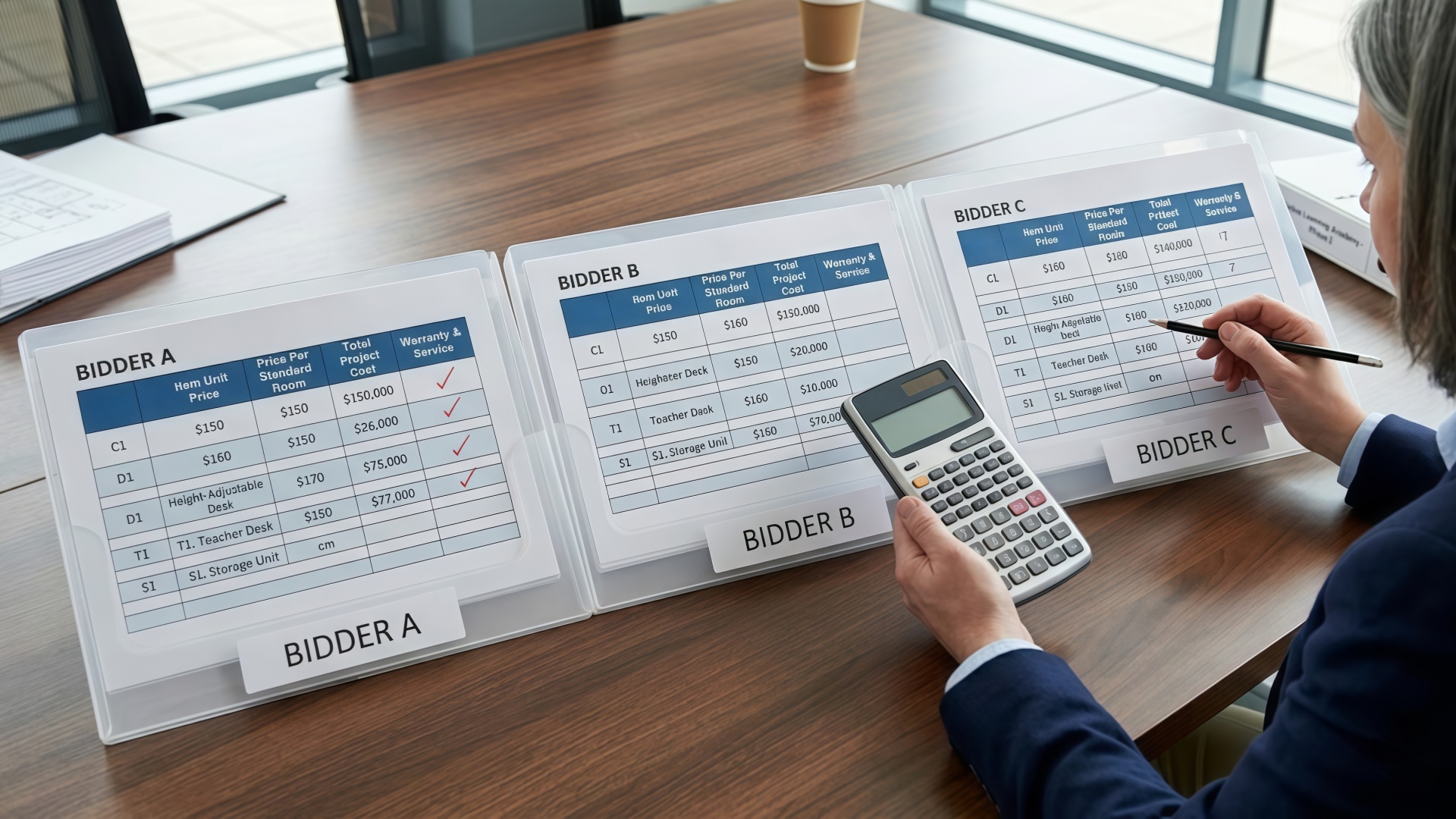
Unstructured pricing is one of the main causes of confusion when comparing tenders. To avoid this, your education furniture tender checklist should include a standardized pricing template. For example, you may require unit prices per item, extended prices per room type, and total project prices, all broken down by product family.
A concise table format that can be used in your pricing template might look like this:
| Parameter / Option | Description |
Item unit price | Price per unit for each specified furniture item |
Price per standard room | Extended cost for a fully furnished typical room |
Total project cost | Sum of all items across the entire scope |
Installation cost | Separate line item for installation and assembly |
Warranty and service | Any cost impacts related to extended warranties |
In parallel, the RFQ must specify required Incoterms, expected delivery timelines, installation responsibilities, and payment terms. If your institution expects deliveries within a specific window or requires staged deliveries across phases, these conditions belong in the core school furniture RFQ documents so that bidders can factor them into their pricing and logistics plans.
Even the best draft RFQ can fail if it is not properly reviewed and controlled before publication. This section focuses on internal and external review processes that strengthen the quality and robustness of educational furniture procurement documents. Proper governance here protects your institution from both technical and commercial risks.
Draft specifications, schedules, and layouts should never be issued without review from key stakeholders. At a minimum, involve facilities or estates teams, educators who will use the spaces, IT specialists where technology is integrated with furniture, and health & safety officers. Each group brings different priorities, and their feedback ensures that the educational furniture procurement checklist is comprehensive.
Documenting sign‑off procedures is equally important. Establish a simple workflow indicating who must approve the room data sheets, technical specifications, and school furniture RFQ documents. When sign‑off is recorded, it becomes much easier to manage later changes and understand their impact on time and cost.
For major projects or new furniture concepts, consider including provisions for sample evaluation or classroom mock‑ups. This might mean installing a small number of sample desks and chairs in a test classroom and allowing teachers and students to use them for a short period. Their feedback can reveal practical issues that might not be obvious on paper, such as noise levels, ease of movement, or comfort during long lessons.
Incorporating pilot feedback before issuing a final RFQ or before awarding a full contract can improve the quality of your education furniture tender checklist. It can also prevent large‑scale deployment of products that technically meet specifications but do not perform well in real use. The modest investment in time and sample costs often pays off in improved satisfaction and fewer complaints down the line.
Finally, implement a simple compliance checklist to verify that all required documents, standards, and tests are referenced before you publish the tender. This might include confirming that every product category has defined performance criteria, that emission limits are clearly stated, and that all relevant safety norms are specified. Completing this compliance check becomes a mandatory step in your educational furniture procurement checklist process.
Equally important is defining how changes to specifications will be handled after the tender issue. Without a clear change‑control process, small adjustments can accumulate into major scope creep, increasing cost and delaying delivery. Your RFQ or contract should state how changes are requested, evaluated, approved, and documented, and how they affect pricing and timelines. This protects both the institution and the supplier from misunderstandings.
Comprehensive, well‑structured procurement documents and specifications are essential if you want to secure safe, durable, and pedagogically appropriate furniture rather than simply the cheapest offer on the table. A carefully designed educational furniture procurement checklist ensures that every aspect—from space inventory and pedagogical intent to technical standards and supplier submissions—is clearly documented and aligned. When that happens, you gain stronger competition between bidders, more accurate pricing, and a much higher chance of on‑time, on‑budget delivery.
Hongye Furniture has extensive experience supporting institutions with school furniture RFQ documents and complete education furniture tender checklist reviews. As an industry leader, the company can work with your team to audit existing specifications, recommend improvements based on current standards, and propose product solutions that match your teaching models and lifecycle expectations. Whether you are planning a small refurbishment or a multi‑campus rollout, partnering with a specialist can dramatically reduce risk and internal workload.

As a next step, consider consolidating your current room lists, specifications, and drawings into a draft package and inviting Hongye Furniture to provide feedback or a pilot proposal. You can also request sample products, download technical catalogs, or arrange a dedicated consultation to review your school furniture specification checklist line by line. By choosing a supplier that prioritizes compliance, safety, and social responsibility, your institution not only protects its investment but also demonstrates a clear commitment to healthy, inclusive learning environments for every student.


 English

