
Views: 0 Author: Site Editor Publish Time: 2026-05-21 Origin: Site


For any capital project in education, understanding school furniture lead time China is as critical as selecting the right products. If furniture arrives late, even the best building hand‑over can quickly turn into a crisis: classrooms stand empty, temporary desks are rushed in at premium cost, and your team spends weeks fighting fires instead of focusing on teaching and commissioning. Aligning education furniture delivery time with construction milestones, term dates, and funding windows is therefore a core responsibility for school and university procurement, project managers, and logistics planners.
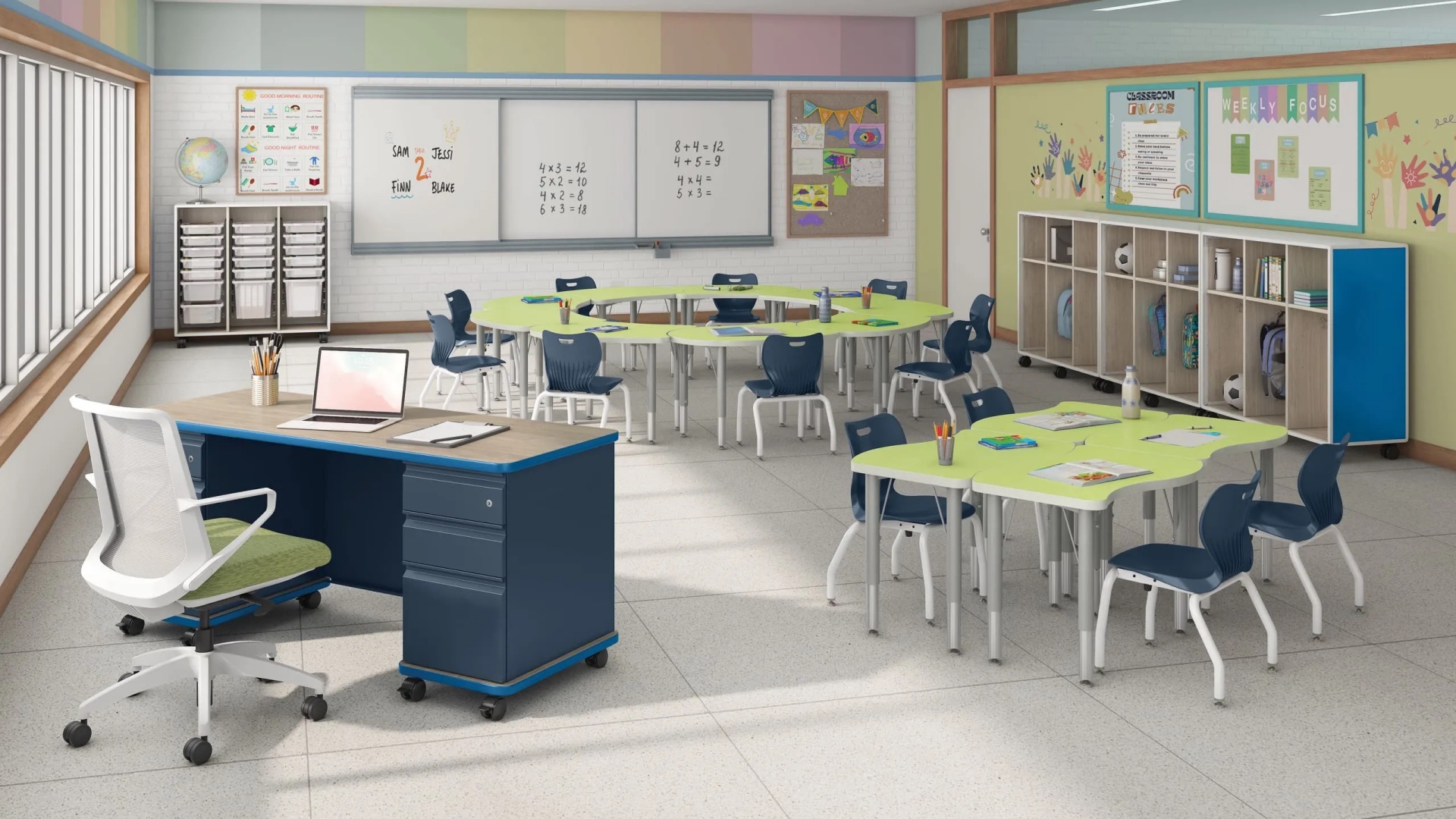
In practice, delays are rarely caused by one single issue. More often, they are the cumulative result of underestimating school furniture shipping from China, ignoring production seasonality, leaving too little time for sampling and quality checks, or hitting unexpected customs bottlenecks. This article breaks down each stage of the journey and shows how to build a robust, risk‑aware school furniture project timeline that you can defend internally and execute reliably with your partners.
This guide is structured around the full life cycle of school furniture lead time China, from the first RFQ to the last chair installed on site. We begin by defining the end‑to‑end time components involved in sourcing from China: pre‑order activities, factory production, and international shipping plus final delivery. By understanding each component, you can see where you have control and where you need buffers.
Next, we look at typical lead time ranges for different product categories—standard classroom desks and chairs versus specialized lab, library, dormitory, and auditorium furniture—and how order volume and customization change the picture. We also provide an indicative table summarizing production lead time bands so planners can quickly sense‑check supplier promises.
Finally, we provide a practical planning checklist and a set of coordination tactics. These include managing key time drivers, integrating milestones into your overall school furniture project timeline, and using communication, contracts, and logistics partners to keep education furniture delivery time on track.
When you plan a project, it is tempting to think of lead time as one number—“10 weeks” or “14 weeks.” In reality, school furniture lead time China is the sum of several distinct phases. By breaking these phases down, your team can allocate time more realistically and avoid compressing critical activities like sampling and quality control into impossible windows.
Broadly, you can think in three stages: the pre‑order phase (requirements, RFQs, samples, approvals), the production phase (manufacturing and internal quality checks), and the shipping and last‑mile phase (freight, customs, and on‑site installation). For a typical medium‑size school or university project sourcing by sea, the total cycle from signed contract to ready‑for‑use furniture usually ranges from 12–20 weeks, depending on complexity and season.
The pre‑order phase often takes longer than teams expect, especially when working with new suppliers or customized furniture. This is where you define technical requirements, issue RFQs, compare offers, negotiate terms, and approve samples or mock‑ups. For a complex project, this phase alone can take 4–8 weeks, yet it is frequently squeezed into just a couple of weeks in internal programmes.
A robust school furniture project timeline should include:
RFQ and clarification period: 1–3 weeks to issue RFQs, receive questions, and collect complete quotations.
Evaluation and negotiation: 1–2 weeks to compare offers, confirm technical compliance, and negotiate commercial terms.
Sample production and testing: 2–3 weeks (or more for custom items) for the supplier to produce samples, ship them by air, and receive your feedback. Where third‑party lab tests or on‑site mock‑ups are required, you may need an additional 1–2 weeks.
For first‑time projects with a new partner, it is wise to assume the upper end of these ranges. Cutting this phase too tight increases the risk of approving designs late or moving into production with unresolved details, which then pushes out education furniture delivery time or leads to on‑site modifications.

Once designs are frozen and samples approved, the factory can begin production. At this stage, school furniture lead time China is influenced mainly by material availability, production capacity, and product complexity. For standard classroom desks and chairs using existing tooling and standard colors, many factories quote production lead times of 30–45 days from deposit payment to goods ready for shipment.
However, several factors can extend this:
Peak seasons: The back‑to‑school period and the months before Chinese New Year are typically peak production times. If orders are placed close to these peaks, lead times can stretch by 2–4 weeks as factories run at full capacity.
Custom materials and finishes: Special laminates, custom powder‑coat colors, or non‑stock fabrics require additional procurement time, often adding 1–3 weeks.
Complex products: Lab benches, library systems, and dormitory sets require more steps (metalwork, woodworking, upholstery) and more internal coordination, so their production cycles are often closer to 45–60 days.
The safest approach is to ask each supplier for product‑specific production lead times and check how these compare with their historic performance and references. A good partner will explain how their planning works, what their monthly capacity is, and how they handle multiple large orders in parallel.
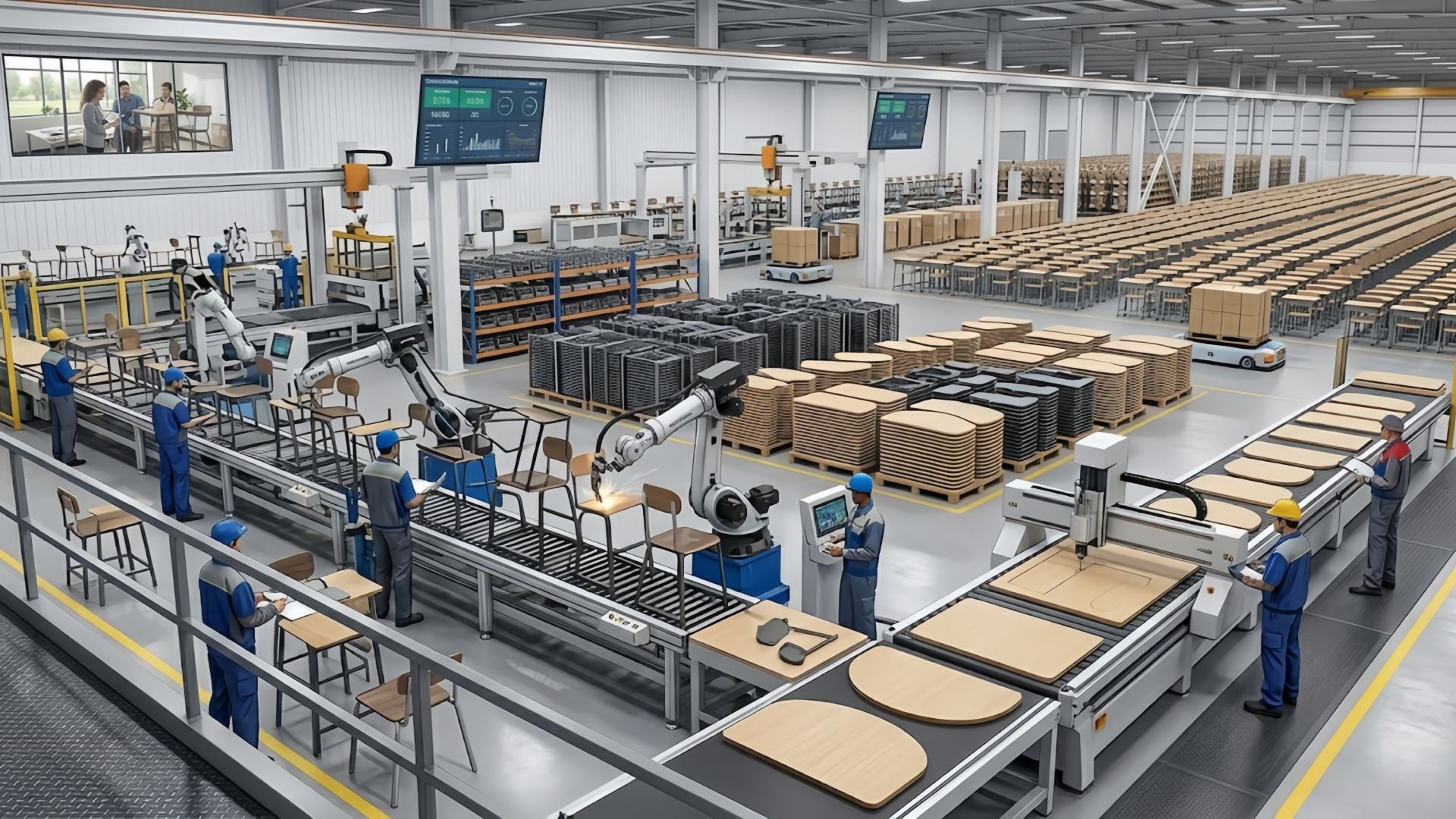
After production and local quality checks, goods must move from the factory to your campus. For most medium‑ and large‑scale projects, the default mode is sea freight, which offers the lowest cost per cubic meter for school furniture shipping from China. But sea freight adds its own time layer and variability that must be accounted for in your schedule.
Typical components of this phase include:
Factory to port and export procedures: 3–7 days for export booking, trucking to port, and export customs clearance.
Ocean transit time: Depending on the route, port pair, and carrier, ocean transit is usually 2–6 weeks. For example, South‑East Asia and some Middle East ports may be closer to 2–3 weeks; Europe, Africa, or the Americas may range between 4–6 weeks.
Destination port handling and customs: 3–10 days for vessel discharge, container availability, import customs clearance, and any inspections.
Inland transport and delivery to site: 1–7 days depending on distance, regulation, and local logistics conditions.
For planning purposes, many project managers assume 6–8 weeks from “ready on factory floor” to “delivered to campus” for sea‑freight shipments. Air freight or rail can reduce transit time to 1–3 weeks end‑to‑end, but at significantly higher cost. These modes are best reserved for urgent top‑up orders or critical items in a school furniture project timeline rather than the core volume.

Once you understand the general phases, the next step is to apply realistic lead time ranges for each furniture category and order profile. Different product types behave very differently in production, and using a single estimate for all items is one of the main reasons that education furniture delivery time assumptions turn out to be wrong.
Standard classroom desks and chairs are usually the fastest category to produce because they use established designs, existing tooling, and high‑volume component lines. For a typical order of several hundred to a few thousand sets with standard finishes, production lead times in China are often in the range of 25–40 days, assuming materials are available.
Two factors can shift this range:
MOQ and color options: If you choose special frame colors or non‑standard board decors, the factory may require minimum order quantities for powder, laminate, or edge banding. Meeting these MOQs is rarely a problem for large projects, but it still adds time to procure and set up new materials.
First‑time vs. repeat orders: Repeat orders using the same specifications as previous projects can move faster because drawings are approved, jigs are ready, and quality criteria are well understood. In some cases, lead time for repeat orders can be reduced by 20–30% compared with first‑time runs.

Specialized items tend to have longer education furniture delivery time because they are more complex and involve more materials and processes. For example:
Lab benches: These often include steel frames, high‑pressure laminate or epoxy tops, integrated sinks, and sometimes services like gas or power. Production may require more detailed drawings and coordination with MEP teams, giving typical lead times of 45–60 days for mass production.
Library shelving and study carrels: Library systems include modular shelving, integrated lighting or power, and custom panel finishes. Lead times can range from 35–55 days, especially where there are many unique units.
Dormitory sets: Beds, wardrobes, desks, and storage for dorms combine woodwork and metalwork and must meet higher structural loads. Expect 40–60 days for larger volumes.
Auditorium and lecture seating: Fixed or retractable seating involves complex frames, upholstery, and sometimes step structures. These projects regularly require 50–70 days for production once drawings are approved.
Multi‑material items (wood, steel, upholstery) add complexity because delays in any one material stream can affect the whole. Effective early coordination with your supplier is key to aligning these sub‑lead times inside the overall school furniture lead time China.

Three variables strongly affect lead time across all categories: customization level, order quantity, and design change frequency.
Customization level: Moving from catalogue items to fully customized designs typically adds 2–6 weeks for design, engineering, prototyping, and sometimes new tooling. Even small changes—such as non‑standard desk depths or unusual panel shapes—can extend the front‑end of your schedule.
Order quantity: Very large orders might benefit from economies of scale, but they also require more production hours, meaning that factories must allocate line time weeks in advance. For projects involving 5,000–10,000+ pieces, it is realistic to expect production to sit at the higher end of typical ranges.
Design changes: Late scope changes, such as adding items, changing dimensions, or switching fabric collections after sampling, can easily add 1–4 weeks if they affect materials already procured or drawings already signed off.
To keep school furniture lead time China under control, it is vital to lock specifications as early as possible and treat any changes after design freeze as exceptional, with clear approval procedures and timeline impact analysis.
To support quick planning, the table below summarizes indicative factory production lead time ranges (excluding international shipping) for common categories under typical conditions:
| Parameter / Option | Description |
Standard desks & chairs (catalogue) | Approx. 25–40 days production lead time |
Lab benches & science furniture | Approx. 45–60 days due to higher complexity |
Library, dormitory, public‑space items | Approx. 35–60 days depending on customization |
Fully customized solutions | Add 2–6 weeks on top of baseline category lead time |
These bands provide a starting point. You should always verify them against supplier‑specific capacity, seasonality, and your own historical data. For more detailed category‑specific examples, you can also refer to a specialist article on bulk school furniture lead times from China.
This section serves as a practical checklist of the main time drivers that shorten or extend school furniture lead time China. It also outlines concrete actions you can take as a buyer or project manager to keep timelines within your risk tolerance.


Charterhouse Lagos | Education Project by Hongye Furniture
Supplier capacity and production planning
Assess each supplier's monthly capacity and current order book. A factory that can produce 10,000 student sets per month but is already 80% loaded will offer very different education furniture delivery time from one operating at 50% capacity. Ask for current lead time commitments to other clients, especially in peak months.
Discuss how the supplier sequences orders during busy periods. Do they prioritize long‑term partners, frame production by region, or queue strictly by contract date? Understanding this helps you interpret their promises and position your project appropriately.
Product complexity and customization level
Recognize that fully customized items—unique dimensions, special laminates, bespoke steel tooling—almost always take longer to engineer and produce than catalogue pieces. Where your schedule is tight, consider using semi‑standard configurations that still align with your pedagogy but rely on existing tooling.
When customization is unavoidable, freeze the design as early as possible and avoid iterative changes after sampling. Each new revision may require updated drawings, re‑quotations, and in some cases new samples, which prolong the school furniture project timeline.
Material availability and supply chain stability
Raw material lead times can become critical bottlenecks. Boards, steel tube, upholstery fabrics, and fittings all have their own supply cycles which can be impacted by global events and price spikes. Ask your suppliers where they source key materials and what the typical incoming lead times are.
For high‑risk or long‑lead materials, consider backup options or dual sources. For example, approving two acceptable fabric ranges rather than one can give the factory flexibility to switch if a particular mill is delayed, reducing the risk of cascading delays.
Quality control and inspection approach
Rigorous quality control is non‑negotiable, but it also takes time. Build in time for internal factory QC, corrective actions, and, if required, third‑party inspections. A typical pre‑shipment inspection can take 1–3 days including report preparation, with additional days needed if corrective work is identified.
Decide early whether your project will use third‑party inspectors or rely on supplier QC plus remote documentation (photos, videos). Once decided, embed these steps into your educational furniture procurement checklist and communicate them clearly so factories can plan.
Shipping mode, route, and seasonality
Transit times for school furniture shipping from China vary by route and season. Peak global shipping periods (e.g., pre‑Golden Week, pre‑Christmas, pre‑Chinese New Year) often see vessel space constraints and longer transit times or port congestion, adding 1–3 weeks compared with off‑peak periods.
For critical items, air freight or rail can be used as a contingency, reducing transit to 1–3 weeks door‑to‑door. However, costs can be 3–6 times higher than sea freight, so these modes are usually reserved for urgent gaps rather than full‑project volumes.
Destination‑country customs and site conditions
Customs procedures and inspection rates differ widely between countries. In some markets, well prepared documentation and experienced local brokers can clear containers in a few days; in others, random inspections can add one or two weeks. Understanding your destination’s typical clearance times helps you set realistic buffers.
Site readiness also affects effective education furniture delivery time. If site access, storage, or installation crews are not ready when containers arrive, furniture may sit idle in storage or on trucks, increasing costs and extending the time until classrooms are truly ready for use.
Knowing the components and drivers of school furniture lead time China is only useful if you translate them into a realistic, integrated project timeline. This section shows how to build that timeline in a way that aligns with academic calendars, construction programmes, and funding releases.
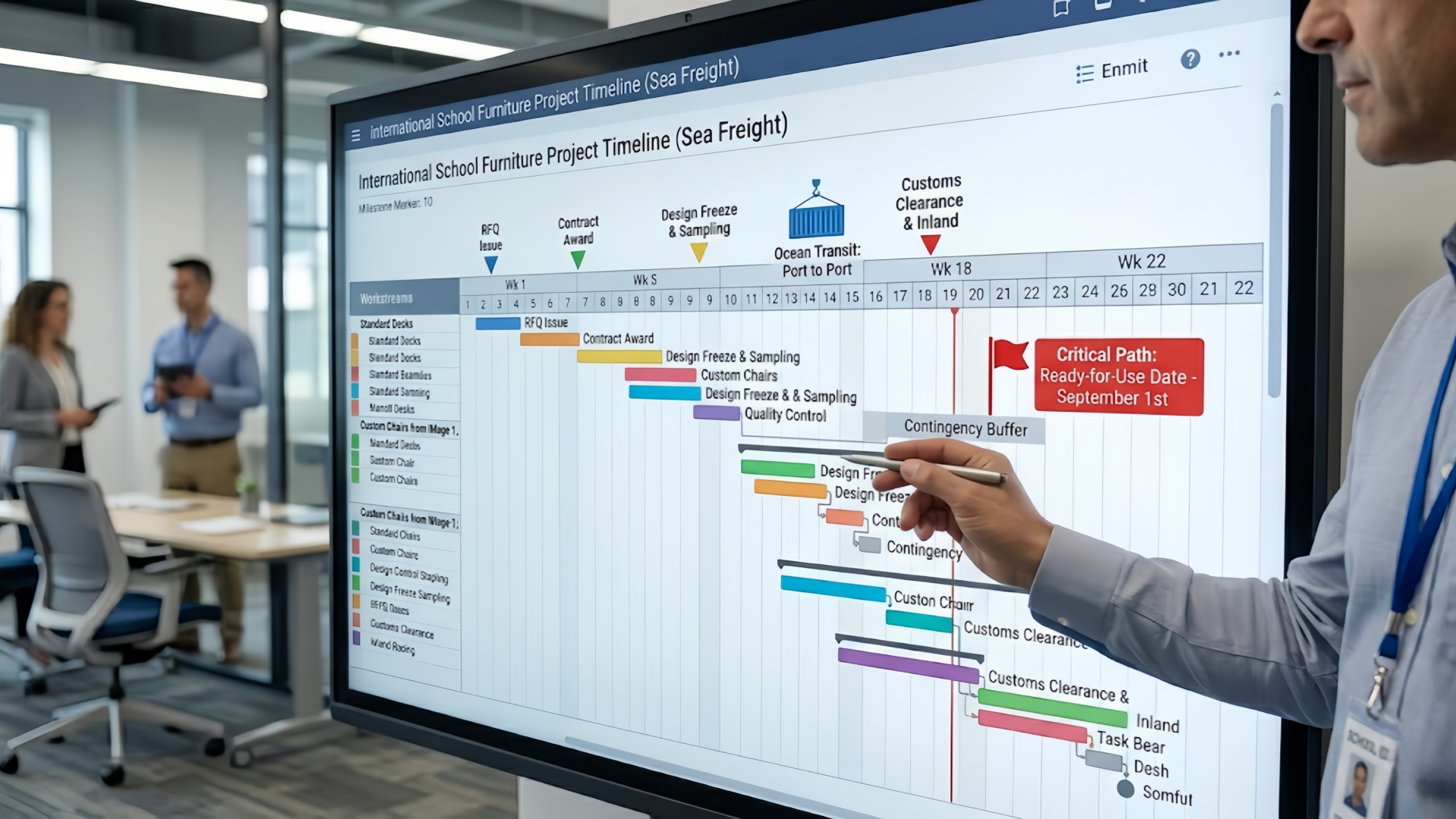
The most efficient approach is to start with your non‑negotiable “ready‑for‑use” date—often the beginning of term or the final building hand‑over—and work backward. Determine when classrooms, labs, libraries, and dormitories must be fully furnished, not just when containers need to arrive. Then add installation, snagging, and contingency time.
For example, if teaching must start on 1 September, you might need all furniture installed and snagged by 15 August, leaving two weeks for final adjustments and cleaning. If installation is expected to take three weeks, your last container arrival might need to be no later than 20 July. From there, you can work backward through customs and shipping to determine the latest factory “ready to ship” date, and then back into production and pre‑order phases.
Once you have those reverse‑engineered dates, you can integrate the main milestones into a single timeline:
RFQ preparation and issue
Bid period and clarifications
Evaluation and contract award
Design freeze and sample approvals
Production window for each package
Quality control and inspection
Shipping, customs, and inland transport
Installation and snagging
Bringing all of these into a Gantt‑style view lets you see where overlaps or conflicts exist. It also helps coordinate furniture with other long‑lead items such as AV systems, lab equipment, and IT infrastructure. For practical visual examples of such sequencing in furniture imports, many buyers study general import guides for office and school furniture from China, which show typical sequencing patterns similar to those described here.
Because no project runs exactly as planned, buffers are essential. The key is to place them strategically at the stages with the greatest uncertainty: sample approvals, production during peak seasons, sea freight during high‑traffic periods, and customs clearance. For instance, you might add a 10–20% buffer on production times in peak season or assume an extra week for customs in riskier destinations.
Scenario planning adds another layer of resilience. By building best‑case, expected‑case, and worst‑case models for education furniture delivery time, you can show stakeholders how much risk is inherent in different strategies. This also helps justify decisions such as paying for earlier order placement, premium shipping in isolated cases, or choosing semi‑standard products over heavily customized solutions.
To make the process more concrete, the table below illustrates an indicative timeline (in weeks) for a medium‑size project sourced by sea from China. This is only an example, but it provides a useful template:
| Parameter / Option | Description |
RFQ, evaluation, and contract award | Approx. 4–6 weeks total |
Design freeze and sample approval | Approx. 3–5 weeks including revisions |
Factory production | Approx. 5–8 weeks depending on category |
Shipping, customs, inland delivery | Approx. 4–8 weeks (route and season dependent) |
Installation and snagging | Approx. 2–4 weeks on site |
This example suggests a total duration of roughly 18–31 weeks from RFQ issue to fully installed furniture. Your actual school furniture project timeline will vary by scope and risk appetite, but this structure gives a clear starting point for internal planning and stakeholder communication.
Even the best‑designed timeline can fail if execution and communication are weak. This final section focuses on coordination practices with Chinese suppliers and logistics partners that help keep school furniture lead time China aligned with your plan.

Establishing a predictable communication cadence builds trust and transparency. Weekly or bi‑weekly update calls or reports should cover key topics such as material procurement status, production progress against plan, quality issues and resolutions, and shipping bookings. Each update should be anchored against your agreed school furniture project timeline, so slippages are identified early.
Sharing your master schedule with suppliers—highlighting non‑negotiable dates and critical paths—helps them understand the real‑world impact of delays. Many successful projects also use simple traffic‑light status dashboards (on‑track, at‑risk, delayed) for each major package, enabling both sides to take corrective actions before problems escalate.
Contracts are another powerful tool for managing education furniture delivery time. Clear clauses should define target shipment dates, delivery windows, and responsibilities under different Incoterms (FOB, CIF, DAP, etc.). When you control the freight, you carry more responsibility for shipping risks; when the supplier delivers DAP, they carry more. This allocation should be deliberate, not accidental.
Consider including provisions for:
Early warning of delays beyond an agreed threshold (e.g., more than one week against plan).
Remedies or incentives, such as liquidated damages for significant, supplier‑caused delays, or bonuses for critical‑path deliveries made ahead of schedule.
Change‑control mechanisms for any scope or specification changes that may affect school furniture lead time China, ensuring time as well as cost impacts are recognized.
Finally, specialist logistics partners play a crucial role in school furniture shipping from China. Experienced forwarders understand optimal routes, carrier reliability, and typical bottlenecks for your destination ports. They can advise on consolidation strategies, such as combining shipments from multiple factories into fewer containers to reduce freight cost, while also flagging any risks this creates for schedule flexibility.
Consolidation is particularly relevant when working with multiple education furniture suppliers. While it can reduce shipping cost, it may also mean that all goods must be ready before containers can depart. Your planners must weigh this against the impact on education furniture delivery time—in some cases, it makes sense to ship critical items separately to protect your opening date. Internal teams that want to explore these trade‑offs in more depth can also study sourcing guides that discuss school furniture procurement from China and common shipping patterns in detail, such as this expert guide.
In global education projects, lead time is not just a logistical detail—it is a strategic variable. When you understand school furniture lead time China in detail, break it into components, and manage each component proactively, you transform lead time from a source of last‑minute crises into a controllable, predictable part of project delivery. By integrating realistic production ranges, shipping durations, and buffers into a single school furniture project timeline, your team can open buildings on schedule and with confidence.
Hongye Furniture, as an experienced education furniture manufacturer and project partner, helps schools, universities, and consultants navigate education furniture delivery time with data‑driven planning and transparent communication. The company combines practical factory capacity planning with optimized school furniture shipping from China, offering clear milestone schedules and flexible options for different project sizes and risk profiles.
If you are planning a new campus or a major refurbishment, now is the ideal time to map your key dates and share them with Hongye Furniture for a preliminary lead‑time assessment. You can request tailored timeline proposals, sample schedules, and RFQ wording examples that embed realistic lead time expectations into your procurement documents. By partnering with a supplier that treats on‑time delivery, compliance, and long‑term reliability as core commitments—not marketing slogans—you protect your budget, your academic calendar, and the learning experience of every student who walks into your classrooms.
How long is the typical lead time for school furniture from China?
For standard projects using sea freight, a typical end‑to‑end lead time from confirmed order to campus delivery ranges from 8–16 weeks. This usually includes 5–8 weeks of factory production and 4–8 weeks for shipping, customs, and inland transport. More complex projects, peak seasons, or heavy customization can extend school furniture lead time China beyond this band, especially if pre‑order sampling and design approvals are not completed early.
What factors have the biggest impact on school furniture lead time China?
The main drivers include product complexity, level of customization, supplier capacity, and material availability, along with shipping seasonality and customs processes in the destination country. Customized lab, library, dormitory, or auditorium furniture usually has longer education furniture delivery time than standard desks and chairs. External factors—such as port congestion or regulatory inspections—can also add 1–3 weeks, which is why experienced planners always include targeted buffers.
How early should schools place orders before the new academic year?
Most institutions find that placing orders 4–6 months before the required “ready‑for‑use” date gives a reasonable safety margin when using sea freight. This window covers sampling, production, and shipping plus contingency for minor delays. For large new builds or heavily customized solutions, starting even earlier—6–9 months ahead—allows more flexibility and reduces the likelihood of costly expedited shipping or temporary furniture arrangements.
Is air freight a realistic option for school furniture shipping from China?
Air freight is technically possible for school furniture but is usually reserved for urgent top‑ups or critical components rather than the full volume, due to its much higher cost and limited capacity. For example, shipping a small batch of replacement chairs or missing library items by air can salvage a deadline, whereas flying several containers’ worth of furniture is rarely economical. Rail freight on selected routes may offer a middle ground between air and sea in both cost and transit time, and can be considered in specific school furniture project timeline scenarios.
How can we build buffers into our school furniture project timeline without over‑padding?
Start by analyzing each stage's typical variability based on historical data—your own and your suppliers’. Then add targeted buffers where variability is highest, such as sample approvals, peak‑season production, and sea freight during busy shipping months. Instead of adding a blanket number of weeks to the whole project, assign smaller, evidence‑based buffers to specific milestones. Scenario planning with best‑case, expected, and worst‑case education furniture delivery time allows you to communicate risks transparently without arbitrarily inflating the schedule.
What should be included in contracts to protect our delivery schedule?
Contracts should clearly define lead‑time expectations, milestone dates, and the responsibilities of each party under the chosen Incoterms. Consider including clauses that require early notification of potential delays, specify corrective action plans, and, for critical projects, outline penalties for unjustified delays or incentives for on‑time or early delivery. It is also important to document how scope changes will affect school furniture shipping from China and overall timelines, so that any decision to change specifications later is made with full awareness of both cost and time consequences.


 English

