
Views: 0 Author: Site Editor Publish Time: 2026-05-19 Origin: Site


Understanding school furniture safety standards by country is no longer optional for organizations delivering international education projects. When you procure classroom furniture across borders, you are not just buying desks and chairs; you are also taking on legal, safety, and reputational responsibility. A compliance failure in one jurisdiction can lead to accidents, regulatory penalties, and costly replacements that wipe out any savings you might have gained from sourcing globally.
For international school buyers, compliance and QA managers, and education project consultants, the complexity lies in the fact that different countries apply different combinations of laws, mandatory regulations, and voluntary standards. Some regions enforce strict ergonomic sizing and emissions limits, while others focus more heavily on fire performance or chemical safety. This guide is designed to help you compare and align education furniture safety standards across key regions, and to build an internal framework that keeps your school furniture regulations consistently under control from early design through to procurement and installation.
This complete guide starts by clarifying the core concepts behind education furniture safety standards: what they usually cover, why they exist, and which organizations actually issue and maintain them. That context is essential before you can interpret how different jurisdictions handle school furniture compliance.
We then move into a region‑by‑region overview of school furniture safety standards by country, focusing on the European Union, North America (US and Canada), and selected Asia‑Pacific and other markets. For each, we highlight the key frameworks and real‑world implications for product selection, testing, and documentation.
Finally, we translate that landscape into a practical, actionable educational furniture procurement checklist that you can apply on multi‑country projects. You will see how to map project countries to applicable standards, define documentation requirements, and embed school furniture specification checklist items directly into RFQs, tenders, and supplier evaluations.
Before you can meaningfully compare school furniture regulations between countries, you need a solid grasp of what these standards actually control. At their core, school furniture standards are about risk reduction: they aim to lower the probability of injuries, long‑term health issues, and safety incidents in environments where children and young adults spend 6–8 hours per day.
In practical terms, education furniture safety standards sit at the intersection of mechanical engineering, ergonomics, toxicology, and fire safety. They specify how strong and stable furniture must be, how it should be dimensioned relative to student body sizes, and which materials or chemical substances are acceptable. For compliance and QA teams, these standards become the technical backbone of any serious school furniture specification checklist.
Across most developed markets, school furniture safety standards by country tend to address a similar set of technical domains, even if the detailed test methods differ. These domains include:
Mechanical safety and overturning resistance: Desks, chairs, and storage units must not topple easily when students lean, climb, or push. Chairs may be required to withstand static loads in the range of 100–130 kg and survive tens of thousands of fatigue test cycles. That level of performance is especially important in secondary schools and universities where students are larger and usage is intensive.
Ergonomic dimensions and size ranges: Standards often prescribe size categories for chairs and tables based on student height or age, ensuring that seat height, backrest angle, and writing surface height are proportionate. Poor ergonomics can increase the risk of musculoskeletal problems and reduce concentration, which is why many European standards, for example, define multiple size marks from small children through to adult learners.
Material and chemical safety: Education furniture is usually subject to limits on hazardous substances such as lead, phthalates, and formaldehyde, particularly where younger children are involved. Boards may need to meet low‑emission grades, and finishes must not flake or release harmful compounds during normal use.
Flammability and fire performance: Upholstered seating, panel materials, and foams frequently need to meet specified flame‑spread or ignition‑resistance criteria. Requirements vary, but in many jurisdictions auditorium seating and residence‑hall furniture are held to higher fire‑safety thresholds than standard classroom pieces.
These elements are particularly important for younger students, whose smaller body size, developing respiratory systems, and more dynamic behavior (running, climbing, leaning back on chairs) make them more vulnerable than typical office users. For QA managers, anchoring your education furniture tender checklist in these risk categories helps you build specifications that are both legally robust and pedagogically sound.
Multiple organizations are involved in writing and maintaining education furniture safety standards. In Europe, technical committees under CEN develop standards such as EN 1729 for school chairs and tables. These standards are then adopted by national standards bodies (for example, AFNOR in France, DIN in Germany) and referenced in local regulations and guidance.
In North America, standards are more fragmented but equally influential. ANSI/BIFMA publishes widely recognized test methods for seating and tables used in educational and institutional environments, while ASTM develops additional test protocols, especially for children's products. Many buyers rely on marks such as BIFMA Compliant to quickly verify that products have been independently tested against baseline performance and safety criteria. For some projects, these marks become explicit requirements in the school furniture RFQ documents.
While the core risk categories are similar, the way each country translates them into law can vary significantly. Some European countries enforce stricter emissions limits for formaldehyde or VOCs than others, and certain US states or Canadian provinces apply their own fire codes or labelling rules to upholstered furniture. As a result, a product that is fully compliant in one jurisdiction may need modifications in another, even within the same region.
For international school buyers and consultants, this means you cannot rely on a single, generic set of specifications. Instead, you must map each target country's school furniture safety standards by country during early design and concept development. Doing so allows you to decide whether a single product line can serve multiple markets, or whether you need variants to meet specific fire, emissions, or dimensional requirements. Integrating that mapping into your educational furniture procurement checklist prevents costly redesigns when you are already close to tender or installation.
Europe offers a relatively mature and harmonized framework for school furniture regulations, making it a useful reference point for international teams. There is a common foundation built on EN standards, but each country can add its own guidance, enforcement practices, or supplementary rules. Understanding both layers is key if you are sourcing for European schools or international schools that follow European norms.
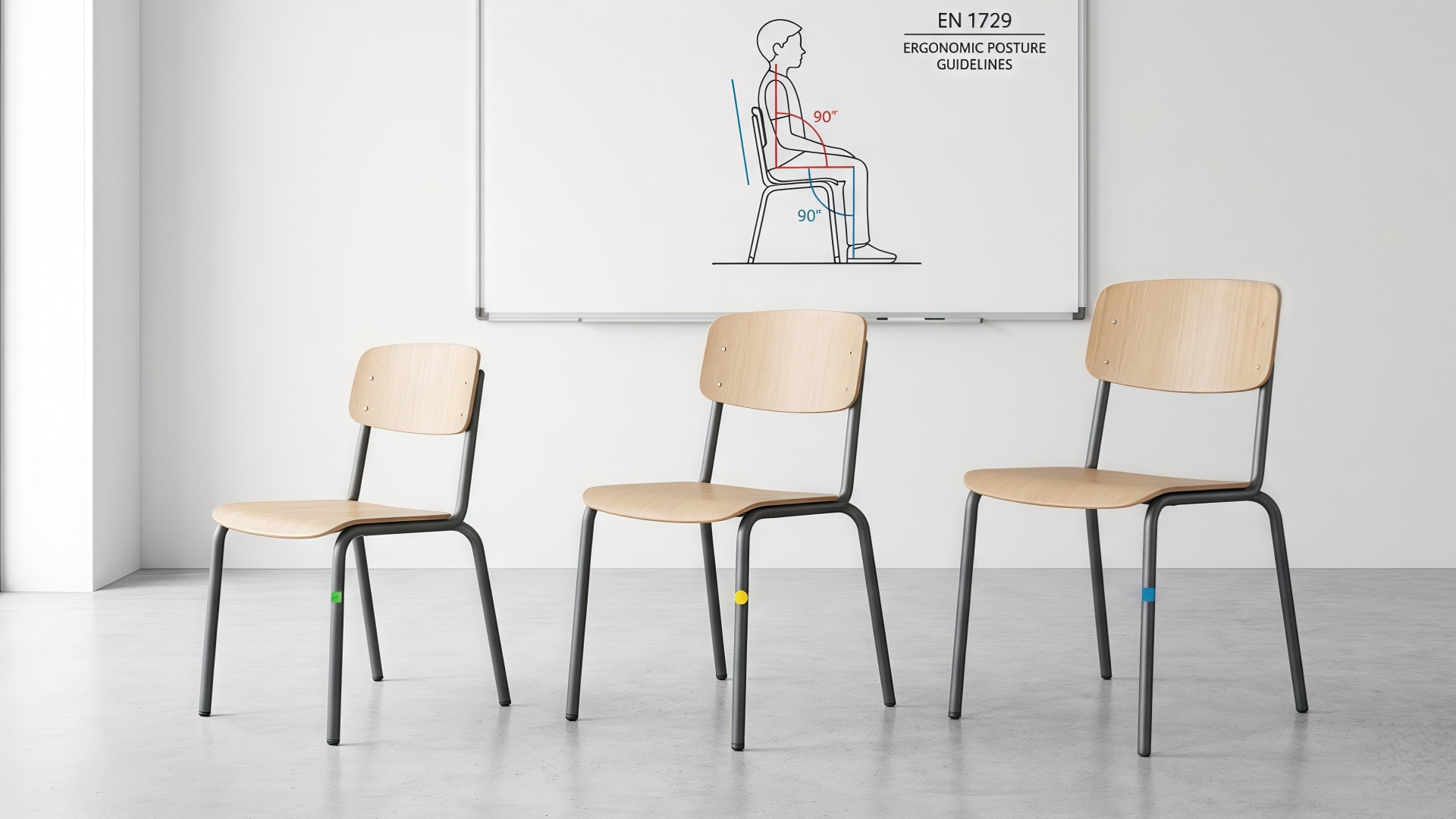
The best‑known European standard for classroom furniture is EN 1729, which is split into two parts. EN 1729‑1 focuses on functional dimensions and ergonomic fit. It defines a series of size marks for school chairs and desks, each corresponding to a particular student height range. In practice, that means a typical school might select 2–3 size marks for different age groups, using color coding on chair frames or labels to help staff deploy the correct size in each classroom.
EN 1729‑2, meanwhile, covers safety requirements and test methods. It specifies performance criteria for strength, durability, and stability, including load tests, fatigue cycles, and overturning resistance. It also addresses details such as minimum edge radii to reduce the risk of cuts and requirements to avoid finger entrapment gaps. For QA managers, referencing EN 1729‑2 in your school furniture specification checklist ensures that bidders must provide products that have passed rigorous, harmonized testing.
To help decision‑makers quickly compare the functional focus of EN 1729, ANSI/BIFMA, and a generic national standard, you can use a simple table like this in your internal documentation:
| Parameter / Option | Description |
EN 1729‑1 focus | Ergonomic dimensions and size marks for students |
EN 1729‑2 focus | Mechanical safety, durability, and stability |
Typical application | K–12 and secondary school desks and chairs |
Common practice | 2–3 size marks per age group with color coding |
This overview helps procurement teams who may not be technical specialists understand why EN 1729 appears in many European school furniture RFQ documents.
Beyond EN 1729, the European Union applies broader consumer‑safety frameworks that influence school furniture compliance. The General Product Safety Directive requires that all consumer products placed on the market be safe under normal or reasonably foreseeable use. Specific standards for children’s furniture complement this requirement, addressing hazards such as sharp edges, small parts, and entrapment spaces.
In practice, CE marking often serves as a shorthand that products meet applicable directives and harmonized standards. However, CE marking alone does not guarantee that an item meets every relevant education furniture safety standard, especially if multiple uses are possible. For school projects, due diligence should include reviewing test reports and declarations of conformity that explicitly reference the standards or directives claimed.
Individual European countries build on these common rules in different ways. France, for example, references EN standards while providing detailed consumer guides that explain to schools and municipalities which norms apply and how to interpret them when purchasing school furniture. These guides can help non‑technical stakeholders understand ergonomic size marks, recommended materials, and basic inspection routines.
Germany, Sweden, and other Nordic countries are known for strong emphasis on ergonomics, environmental performance, and durability in their education systems. Public tenders may require compliance not only with EN 1729, but also with strict emissions classifications and sustainability labels. For international suppliers, this often means proving conformance with both school furniture regulations and eco‑labels or national guidance, which should be clearly reflected in your education furniture tender checklist when targeting these markets.
Compared with Europe, North America takes a more decentralized approach to school furniture safety standards by country, especially in the United States where federal, state, and voluntary standards intersect. For international buyers, this can feel complex, but it can be managed effectively with a structured approach.
This section provides a practical overview of key frameworks, showing you what to look for when assessing North American suppliers and how to reflect these expectations in your school furniture RFQ documents.

Federal and national regulations
At the US federal level, there is no single mandatory standard written specifically for all school furniture, but children’s products must comply with broader laws like the Consumer Product Safety Improvement Act (CPSIA). That includes stringent limits on lead, certain phthalates, and other substances in children's furniture and components. This is critical when specifying products for early childhood and primary education.
The US Consumer Product Safety Commission (CPSC) issues guidance on furniture safety more generally, including risk‑based recommendations for stability and labelling. Some categories of children's furniture require tracking labels and certification based on third‑party testing, and these expectations should be captured in your school furniture specification checklist when sourcing for US schools.
ANSI/BIFMA standards for institutional furniture
ANSI/BIFMA standards cover structural safety, stability, and durability for institutional seating, desking, and tables. These standards are widely used in higher education and institutional environments and often serve as the de facto baseline for performance even when not mandated by law.
The BIFMA Compliant registry allows buyers and QA teams to confirm which products have been tested against specific ANSI/BIFMA standards. For large tenders, specifying that products must be listed or tested to relevant ANSI/BIFMA standards is a practical way to raise the quality bar and simplify due diligence.
ASTM and other test methods for children's products
ASTM develops additional standards for children's furniture and related products, focusing on mechanical safety, entrapment, and other child‑specific hazards. These standards complement ANSI/BIFMA and CPSIA by addressing detailed test methods for particular risk scenarios.
International buyers should request test reports that reference both ANSI/BIFMA and relevant ASTM standards when assessing US‑oriented school furniture, especially for early years and primary classrooms. Including these expectations directly in education furniture tender checklist templates avoids ambiguity during evaluation.
State and provincial fire and flammability codes
Many US states and Canadian provinces enforce their own fire codes or labelling requirements for upholstered furniture. These can specify particular flammability tests or disclosure labels, which are especially relevant for auditorium seating, lounge furniture, and dormitory mattresses.
When using North American products in education projects, you should cross‑check upholstery and foam specifications against the target jurisdiction's fire regulations. This may require selecting different fabric grades or foam formulations for different states or provinces, which should be accounted for in your educational furniture procurement checklist and discussed with suppliers early.
To help internal teams keep track of the North American framework, you can use a table like the one below:
| Parameter / Option | Description |
CPSIA focus | Chemical content and labelling for children's products |
ANSI/BIFMA role | Voluntary performance standards for institutional furniture |
ASTM role | Detailed test methods for specific children's products |
State/provincial fire codes | Additional flammability and labelling requirements |
This structure gives non‑specialist stakeholders a quick, scannable overview of how North American school furniture compliance is organized.
Beyond Europe and North America, the Asia‑Pacific region and other markets present a diverse mix of school furniture regulations. Some countries are major exporters of education furniture; others are rapidly expanding their domestic school infrastructure. For global projects, understanding this diversity is crucial when you are building a multi‑region education furniture tender checklist.
China applies national GB standards and related regulations for children's furniture and school desks and chairs. These standards address structural safety, dimensions, and chemical content in ways that broadly align with international best practices. For example, they include requirements on stability, edge rounding, and limits on hazardous substances similar in intent to those seen in Europe and North America.
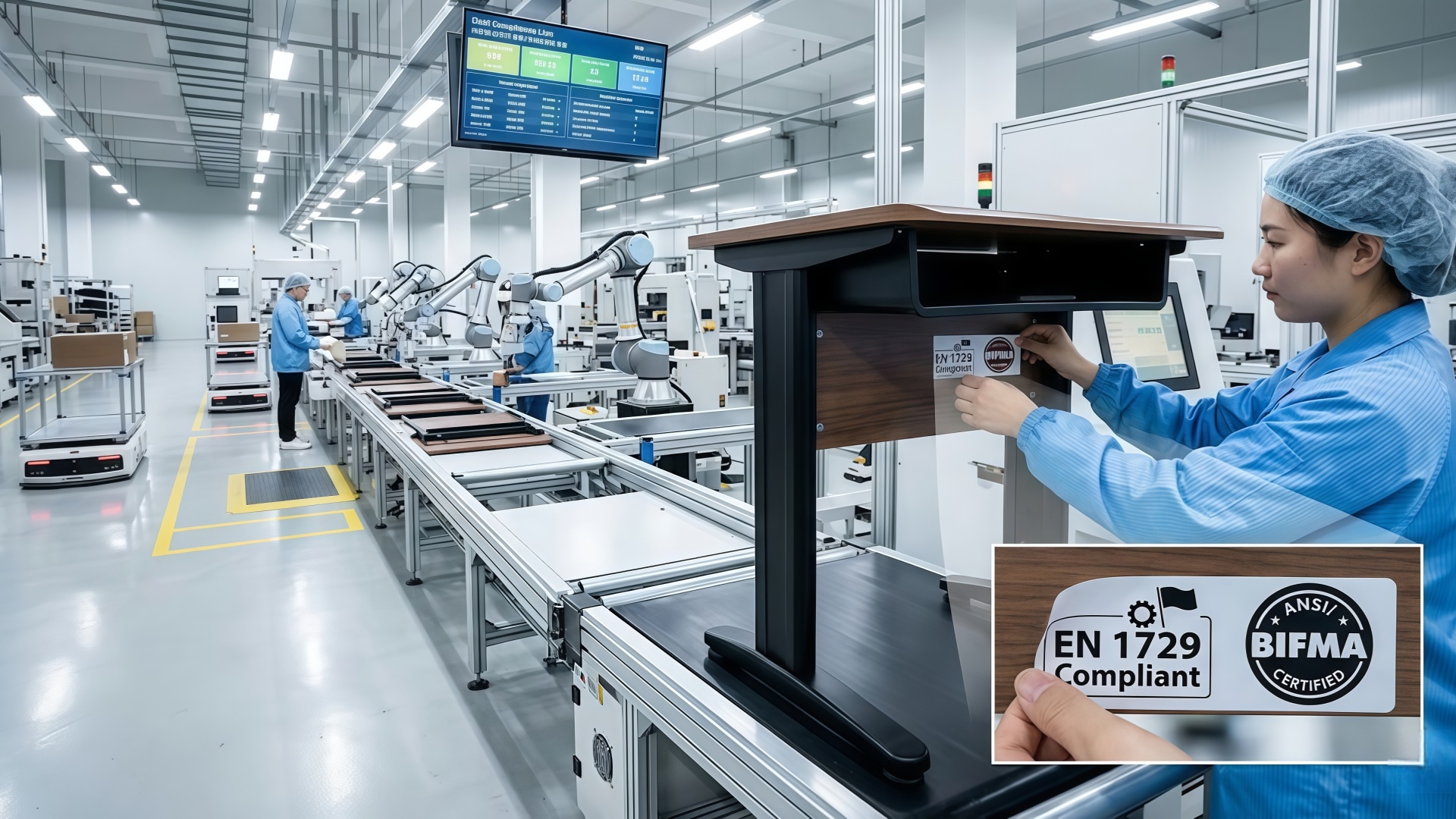
Because China is also a major exporter of school furniture, many manufacturers design product lines that can meet EN 1729 for Europe or ANSI/BIFMA standards for North America. This dual‑compliance capability is valuable for international school operators who want to deploy consistent product families across multiple countries. When evaluating Chinese suppliers, your educational furniture procurement checklist should explicitly ask which international standards their export lines meet, and request corresponding test reports.
Japan, South Korea, and some other advanced Asian economies often enforce robust ergonomic and material standards in their school systems. Domestic guidelines may be influenced by both local research and international norms, leading to precise dimensional systems and high expectations for build quality.
These markets typically favor high‑grade materials, carefully tuned ergonomics, and rigorous testing regimes. For international buyers seeking premium products or case studies of best‑in‑class education furniture safety standards, Japanese and Korean practices can provide a useful benchmark. They also demonstrate how consistent application of ergonomic standards across an entire system can help reduce long‑term health risks for students.


Singapore Institute of Technology | Education Project by Hongye Furniture
Emerging regions in Southeast Asia, the Middle East, Africa, and Latin America can present a patchwork of school furniture safety standards by country. Some governments adopt or reference EN and ANSI/BIFMA standards directly; others rely more on generic consumer‑product laws and building codes. In donor‑funded or international‑school projects, specifying which set of standards applies becomes a key part of the design brief.
For project teams delivering across multiple emerging markets, it is important to clarify early whether local authorities expect compliance with specific EN, ANSI/BIFMA, or national standards. This should be documented in your school furniture specification checklist and communicated to all bidders. It can also influence product strategy: in some cases, it is more efficient to standardize on products that meet the strictest applicable norms and deploy them across multiple countries, rather than maintaining several different configurations.
With the country‑level landscape in mind, the final step is to build an operational school furniture compliance checklist that your organization can use on every project. The objective is to create a repeatable process that captures local requirements, verifies documentation, and embeds standards into procurement decisions.
A strong educational furniture procurement checklist is not just a static document; it is a living tool that connects design, QA, and procurement teams. It should be updated as regulations evolve and linked to related resources, such as country comparison articles or deep dives into European vs. American standards.
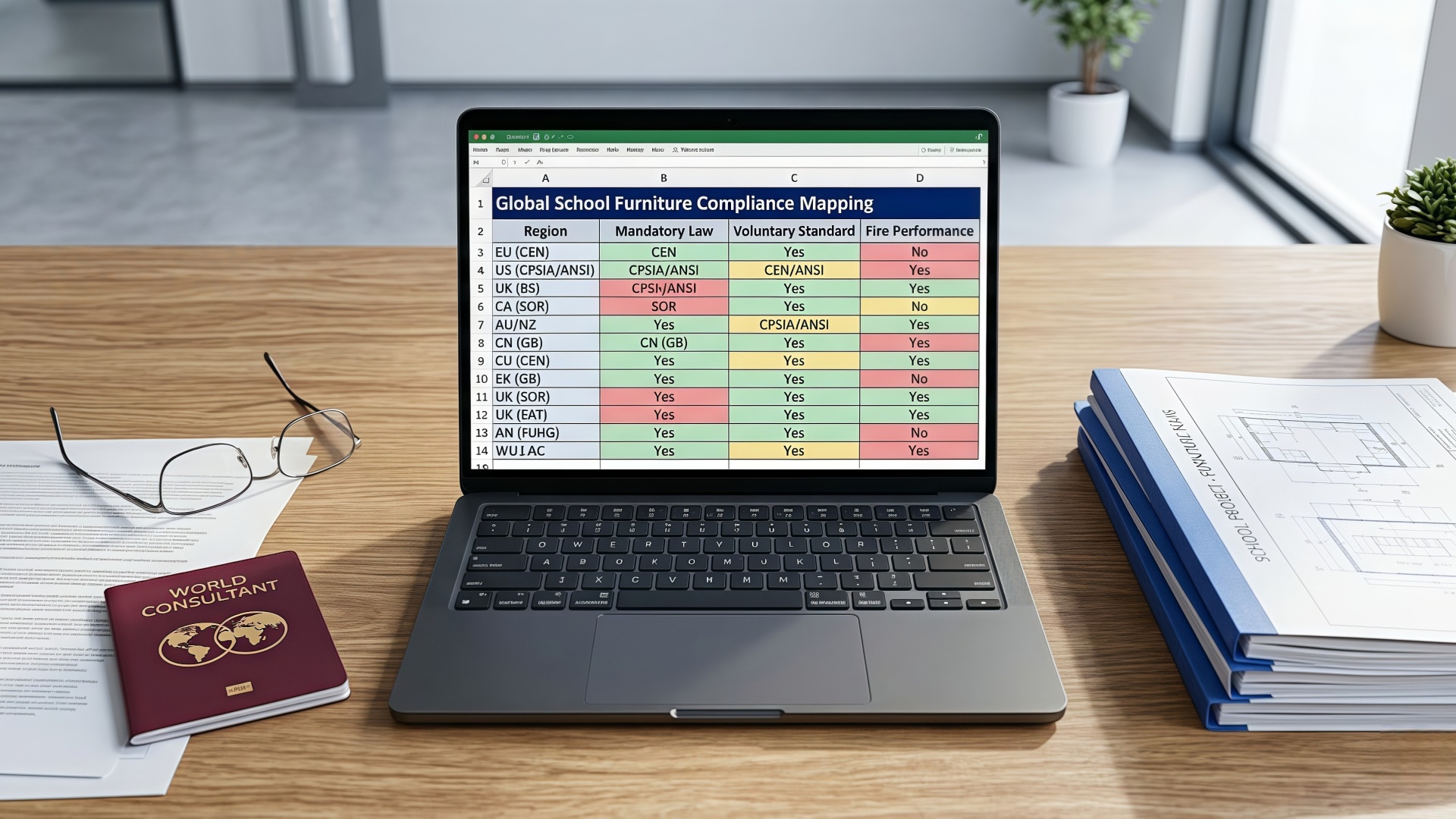
Start by building a matrix that lists each project country alongside the core standards and regulations that apply. For a multi‑site project, this matrix might include EN 1729 for EU countries, ANSI/BIFMA standards for North American campuses, and GB standards for projects in China. You can then add columns for national fire codes, emissions requirements, or any additional local guidance.
This matrix becomes the backbone of your internal education furniture tender checklist. It should be referenced during concept design, product selection, and RFQ drafting. Updating it regularly as regulations are revised or new guidance is published is crucial; standards bodies typically review and update standards every 5–10 years, and some jurisdictions move faster in response to new research or incidents. Sharing the matrix with design, procurement, and QA teams ensures that everyone is working with the same assumptions.
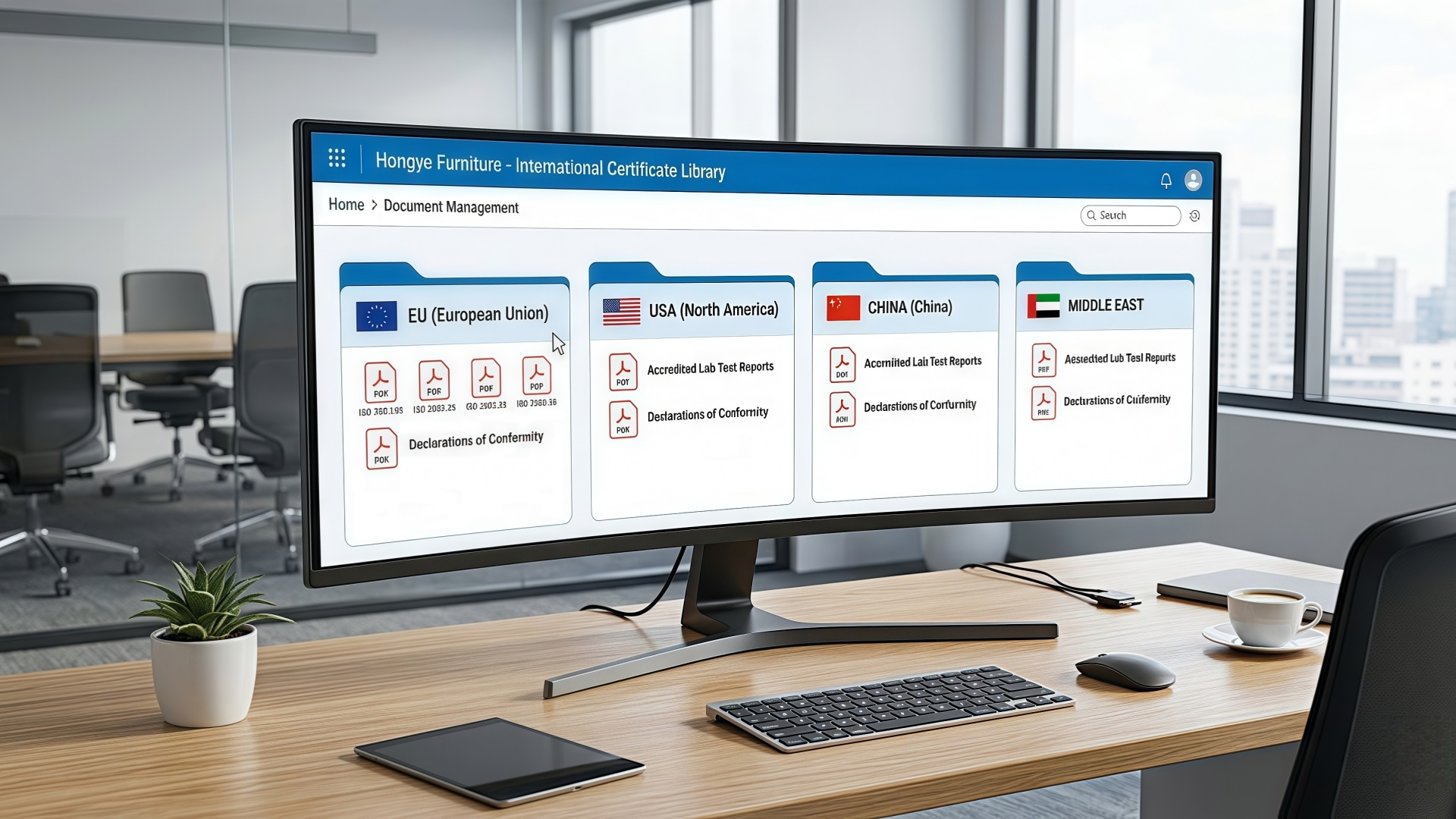
Next, define minimum documentation requirements for every product type and country. At a minimum, this usually includes accredited laboratory test reports, certificates of conformity, and any labels or declarations required by local laws. For European projects, that may involve EN 1729 test reports and CE‑related documentation; in the US, CPSIA and ASTM references; in China, GB standard reports.
Maintaining a centralized, digital library of these documents per product and per country allows you to respond quickly to audits, inspections, or customer queries. It also helps you spot gaps where a product is being sold into a market without adequate documentation. QA managers can build this into the school furniture RFQ documents by specifying which reports must accompany each bid, and by making clear that incomplete documentation is grounds for rejection.
Finally, weave the mapped standards and documentation requirements directly into your RFQs, tenders, and evaluation tools. Your technical specifications should reference specific standards (for example, “desks and chairs must comply with EN 1729‑1 and EN 1729‑2” or “seating must be tested to ANSI/BIFMA X5.x”), and your evaluation forms should include fields where suppliers must confirm compliance and attach evidence.
Structured comparison tables are especially effective here. For example, in a supplier evaluation workbook you might include columns for each relevant standard and a yes/no/compliant‑with‑deviation field. Combined with a school furniture specification checklist, this approach ensures that standards compliance is treated as a go/no‑go criterion rather than an afterthought. Where you are comparing European and American expectations, it can be helpful to reference deeper analyses such as this examination of European and American school furniture standards.
For organizations working across multiple countries, mastering school furniture safety standards by country is essential to delivering safe, compliant, and future‑proof learning environments. A structured approach—anchored in a robust educational furniture procurement checklist, clear RFQ language, and disciplined documentation control—allows you to navigate diverse school furniture regulations without compromising on safety or educational quality.
As an industry leader in this field, Hongye Furniture works with international schools, consultants, and project managers to interpret local education furniture safety standards and translate them into practical, buildable solutions. Whether your projects follow European EN frameworks, North American ANSI/BIFMA standards, or mixed requirements across Asia‑Pacific and emerging markets, Hongye Furniture can support you with product recommendations, test documentation, and specification reviews tailored to each jurisdiction.

To move forward, consider consolidating your current specifications and country requirements into a single matrix, then request a standards review or consultation with Hongye Furniture. You can also ask for sample documentation packs, product test reports, or a customized school furniture compliance checklist that aligns with your internal QA processes. By partnering with a supplier that treats compliance and social responsibility as core values—not afterthoughts—you protect your students, your staff, and your institution’s reputation, while avoiding the hidden costs that come with non‑compliant or poorly documented furniture.
What are the main international standards for school furniture safety?
The main international frameworks include EN 1729 for school chairs and desks in Europe, ANSI/BIFMA performance standards for institutional seating and tables, and various ASTM standards for children's products and specific test methods. These are supported by broader regulatory frameworks such as the EU's General Product Safety requirements and US laws like the Consumer Product Safety Improvement Act (CPSIA), which control chemical content and labelling for children's furniture. Together, they form the reference base many countries use when designing their own school furniture safety standards by country.
How do European school furniture regulations differ from US requirements?
In Europe, school furniture safety is largely built around harmonized EN standards like EN 1729, which provide a common baseline across EU member states and support CE‑related compliance. This creates a relatively uniform framework for ergonomic sizing, structural performance, and safety requirements. In the United States, by contrast, there is no single federal standard for all school furniture; instead, a mix of federal laws (such as CPSIA), voluntary standards (ANSI/BIFMA, ASTM), and state‑level fire and labelling codes applies, so school furniture compliance can vary more from one jurisdiction to another.
Do I need different furniture for each country in a multi‑site project?
Not always, but you do need to test that assumption carefully. Some products are designed to meet multiple education furniture safety standards at once—for example, desks and chairs that comply with both EN 1729 and relevant ANSI/BIFMA standards—making them easier to deploy across several markets. However, differences in fire regulations, emissions limits, or size‑mark systems can still require country‑specific variants or configuration changes. A structured educational furniture procurement checklist and a country‑by‑country standards matrix will help you see where a single product line works and where localized adjustments are necessary.


 English

