
Views: 0 Author: Site Editor Publish Time: 2026-04-14 Origin: Site


If you've ever walked a school project at punch-list and heard, “The tables wobble,” “The teacher can't pull a group without blocking circulation,” or “There are cords everywhere,” you already know the truth: a teacher table isn't a decorative line item. It's a working tool that affects supervision, safety, acoustics, behavior management, and even how quickly a room can shift from whole-group to stations.
For interior designers and project contractors, the fastest path to rework is getting the classroom tables almost right: a top that chips at the edge banding, legs that loosen after a semester, a school table height that doesn't match the grade band, or a small-group table for classroom instruction that consumes too much footprint and kills ADA circulation. This guide focuses on the decisions that actually prevent those outcomes—dimensions, materials, frame specs, layouts, and procurement details you won't see on a standard retail listing.


In most current learning models, the “front-of-room desk” is no longer the anchor. The teacher needs a small group table for classroom instruction (guided reading, math intervention, IEP minutes), plus a mobile teaching station for brief admin tasks. In practice, the teacher table is a high-touch coaching zone: it must be easy to access, fast to reset, and durable enough to handle constant student contact.
That's why the best teacher table for classroom use is typically kidney/crescent shaped in early grades, and modular or tech-ready in upper grades. It's also why “one size fits all” classroom furniture tables fail across a district—different grade bands have different ergonomic heights, different technology loads, and different circulation needs.
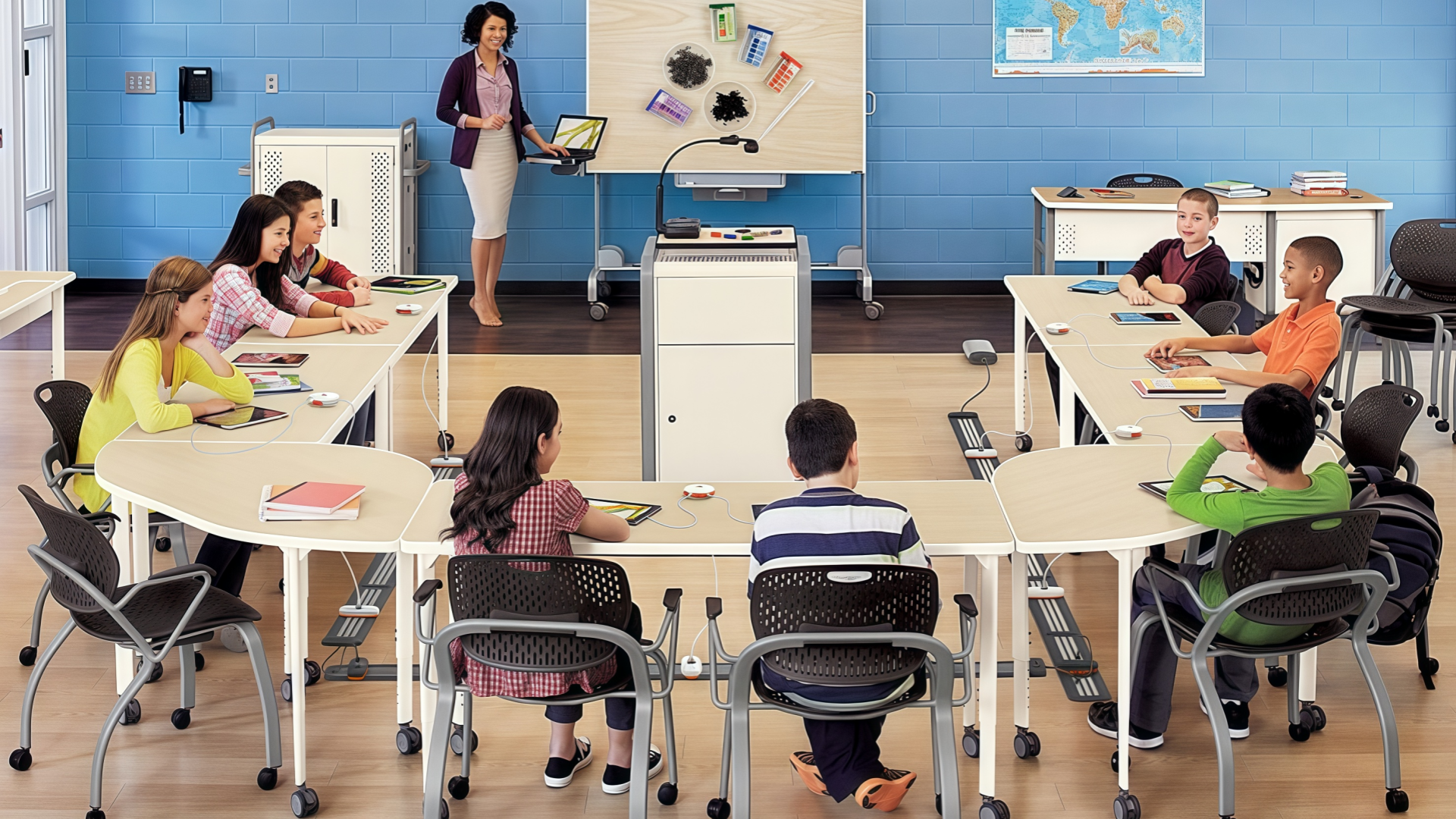
Height is the most common spec mistake, especially when a room is designed by “standard table height” assumptions. For classrooms, you're balancing: (1) student ergonomics (feet supported, shoulders relaxed), (2) teacher access for small-group instruction, and (3) sightlines across the room.
Pre-K / preschool tables: typically 14–18 in. table height.
Kindergarten table / early elementary tables: typically 19–22 in. table height.
Upper elementary classroom tables: typically 22–24 in. table height.
Middle / high school tables: typically 29–30 in. table height (adult standard).
Spec tip: If the district is moving toward flexible seating, consider adjustable-height legs (common ranges: 18–29 in. or 22–30 in.) on the teacher table and key student tables for classrooms. It costs more upfront but prevents the “wrong height for this grade” problem when rooms get reassigned year to year.
Shapes determine coaching access, student spacing, and whether the teacher can monitor the rest of the class while running a group. Here's how common classroom tables perform in real use.
A kidney-shaped teacher table is still the most efficient small-group surface for K–5. The teacher sits in the “notch,” gaining reach to each learner without leaning across a deep top. It also creates natural boundaries between students—useful for writing, manipulatives, and behavior supports.
Look for: a modest depth so the teacher can reach the far edge comfortably (avoid oversized tops that turn into “across-the-table tutoring”).
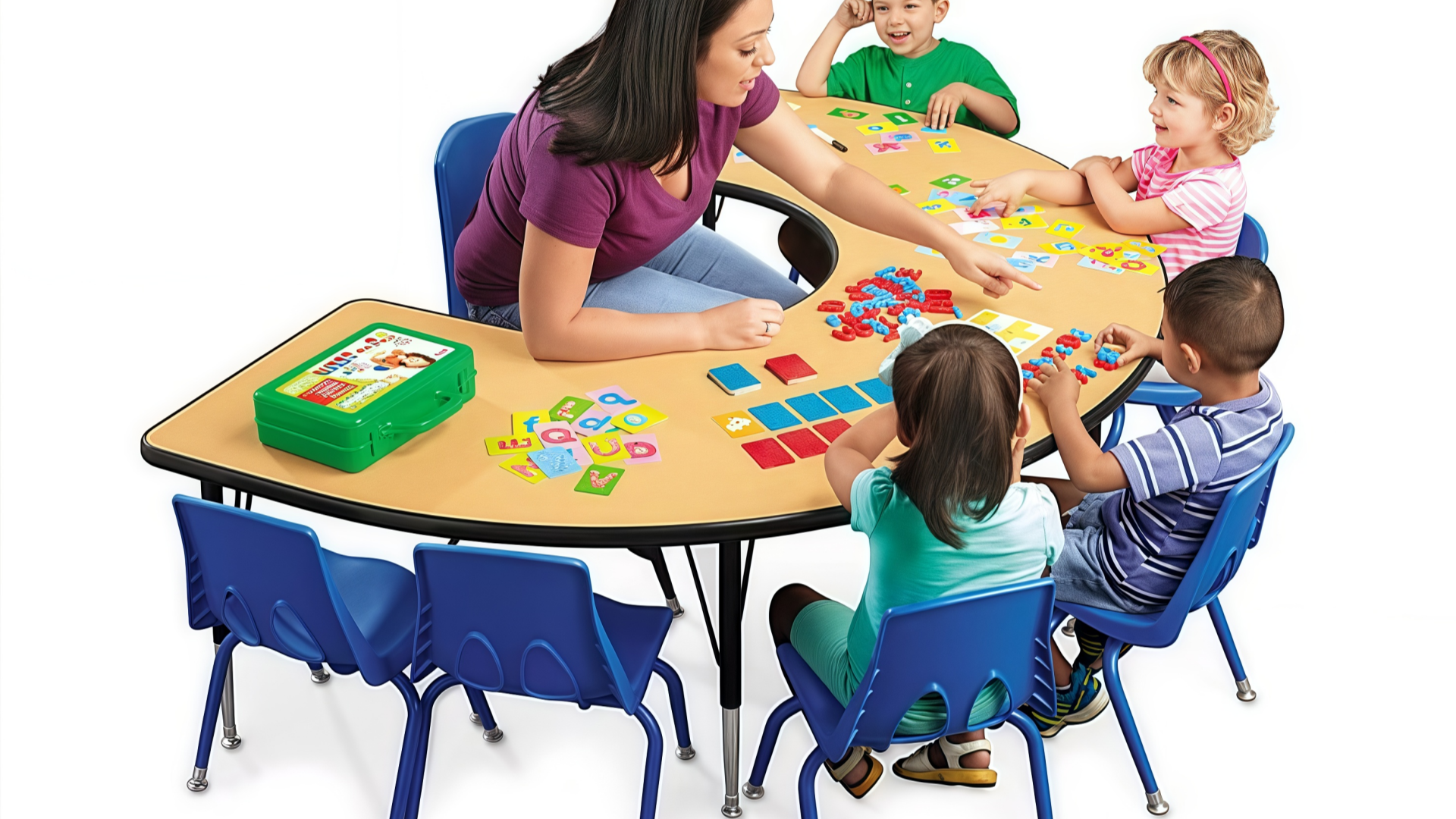
For pull-out services, a U-shape provides maximum visibility of hands and work. It's also excellent when multiple adults support the group. The tradeoff is footprint—U-shapes can eat up circulation quickly in a small classroom table plan.
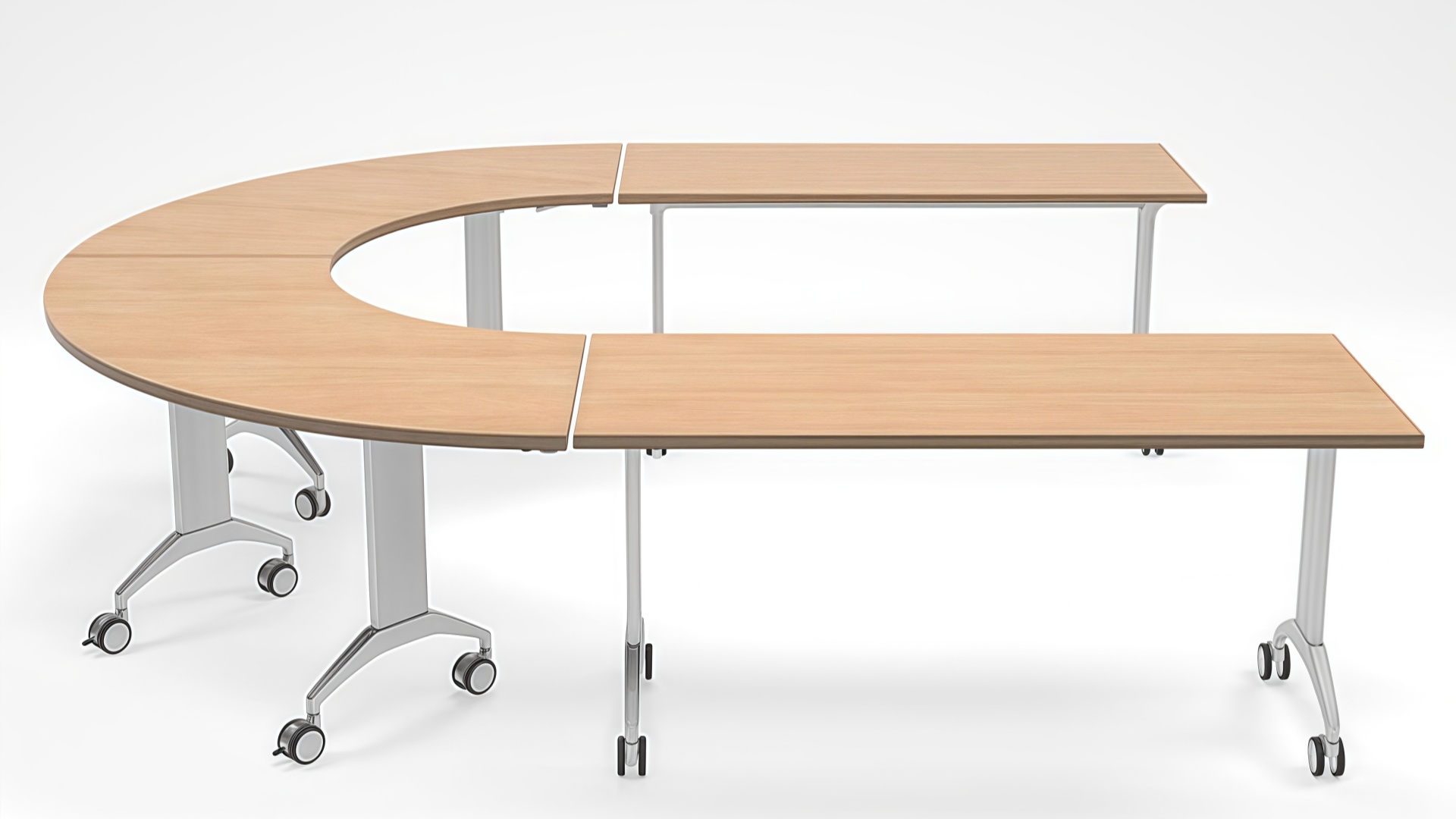
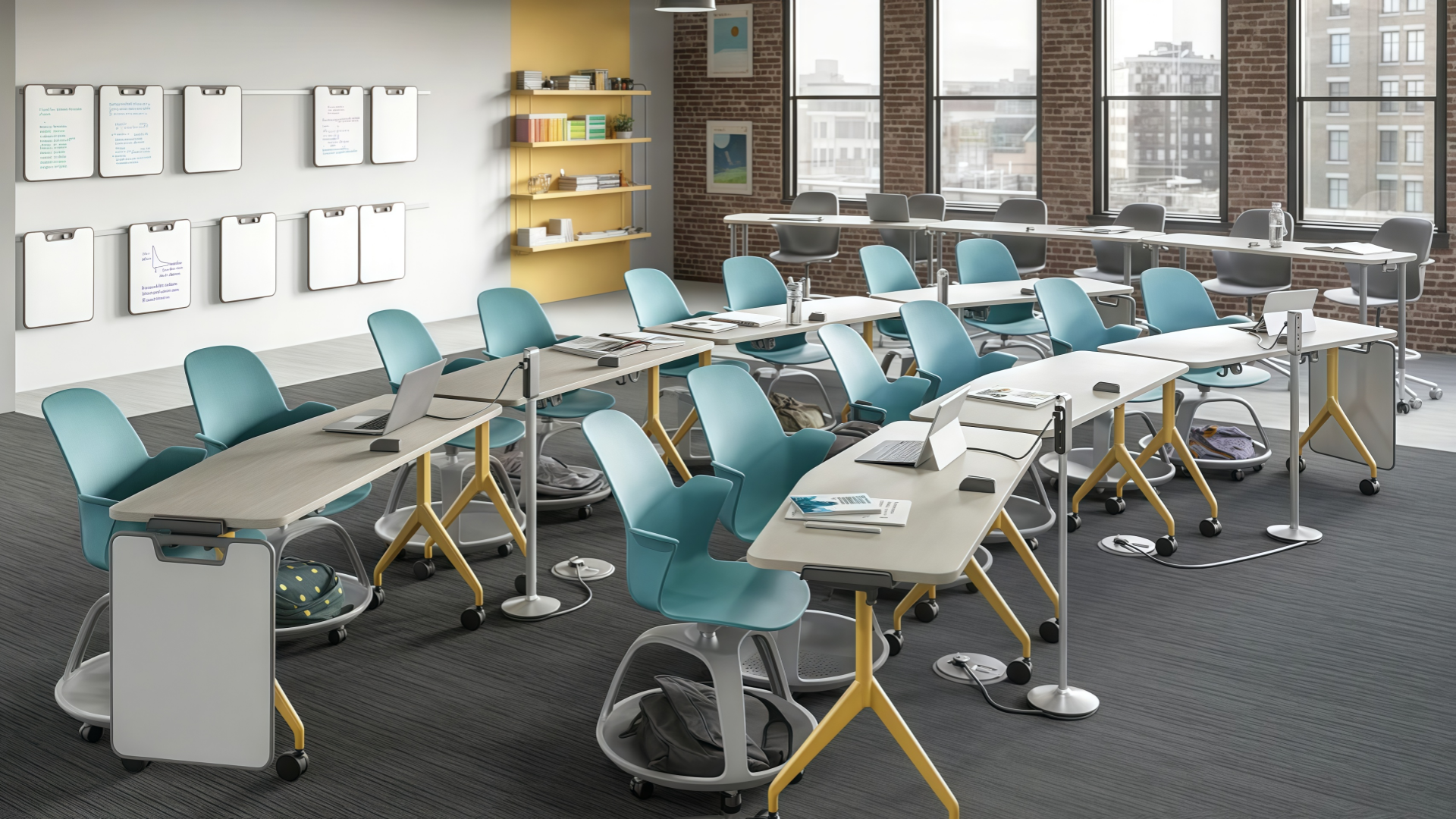
Trapezoids and other modular group tables are the workhorses of project-based learning. You can cluster them for group tables, split them for testing, or form a long benching run for labs. In high school spaces, this can replace fixed casework in lower-intensity STEM rooms.
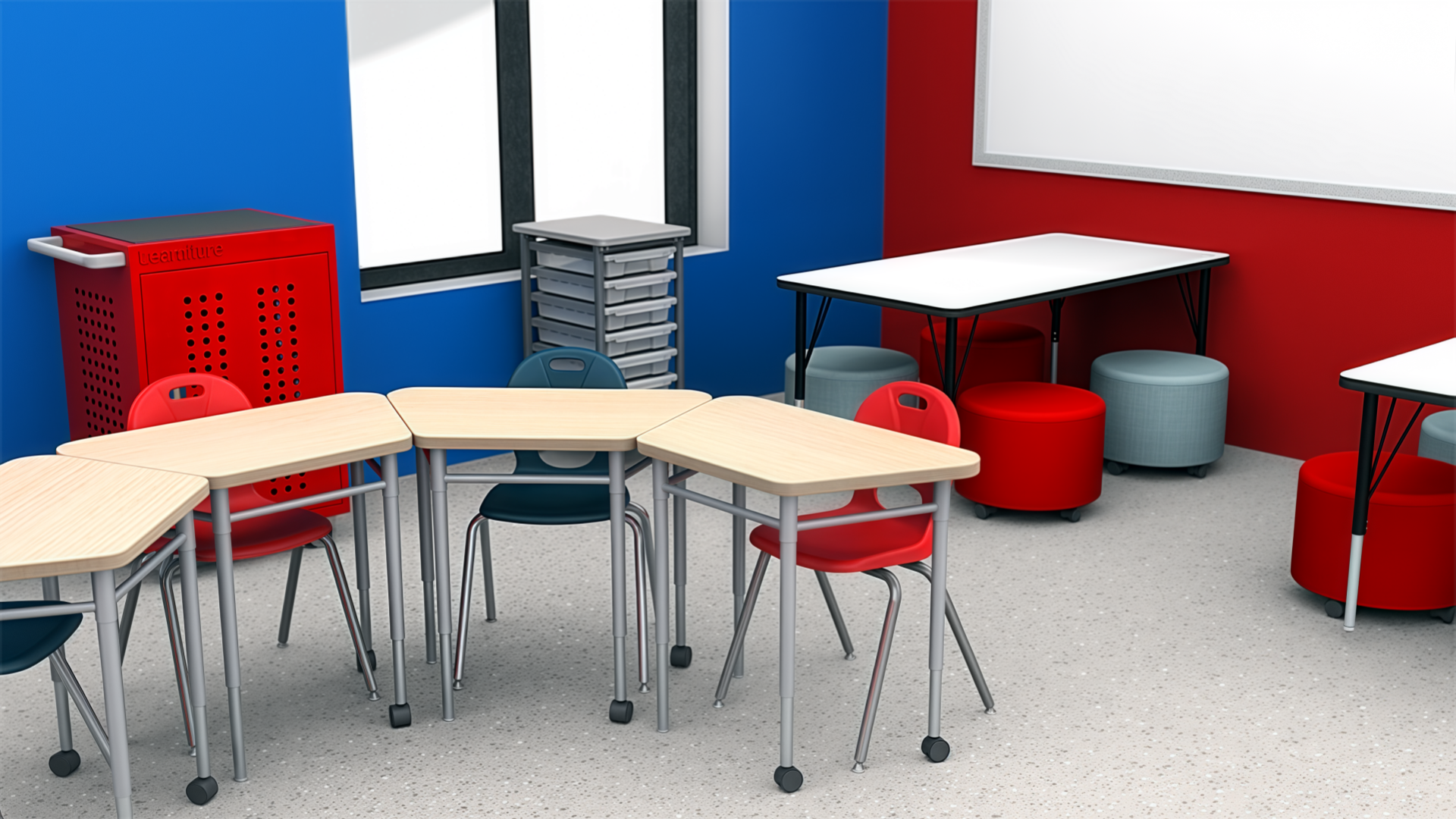
A simple rectangular class table is often the best value when you need flexible capacity and easy replacement. If you're specifying classroom tables cheap for a large rollout, rectangles simplify inventory (fewer SKUs) and reduce lead-time risk.
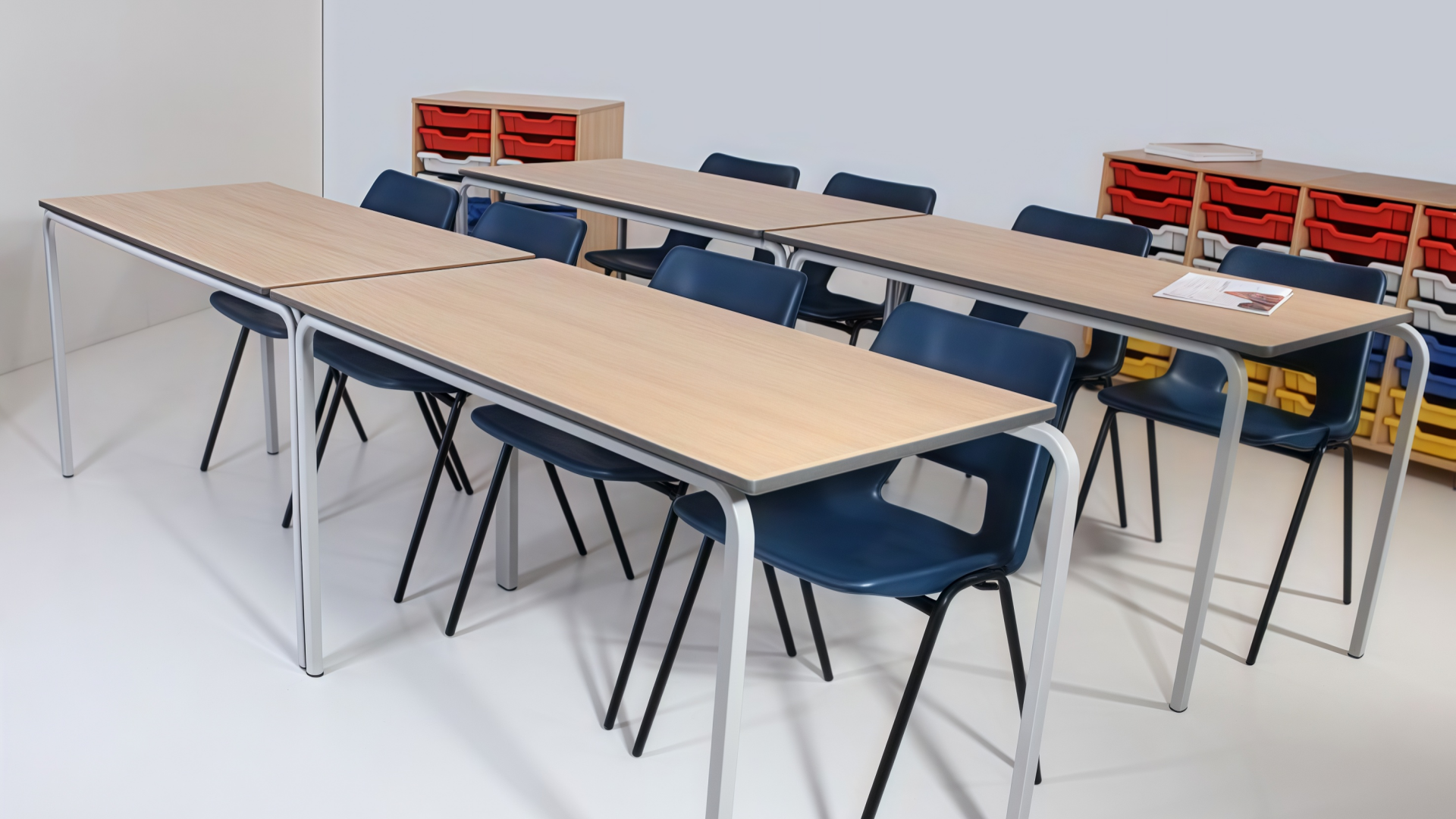
In renovations where you're fighting square footage, skinny classroom tables (shallower tops) can preserve circulation while still fitting a laptop and a notebook. They're especially useful for high school tables when the room also needs lab stools, storage, or mobile whiteboards.
Most failures happen at the same points: edges, wobble, and loose hardware. A school classroom table that looks fine in a catalog can fail quickly if the construction is light-duty.
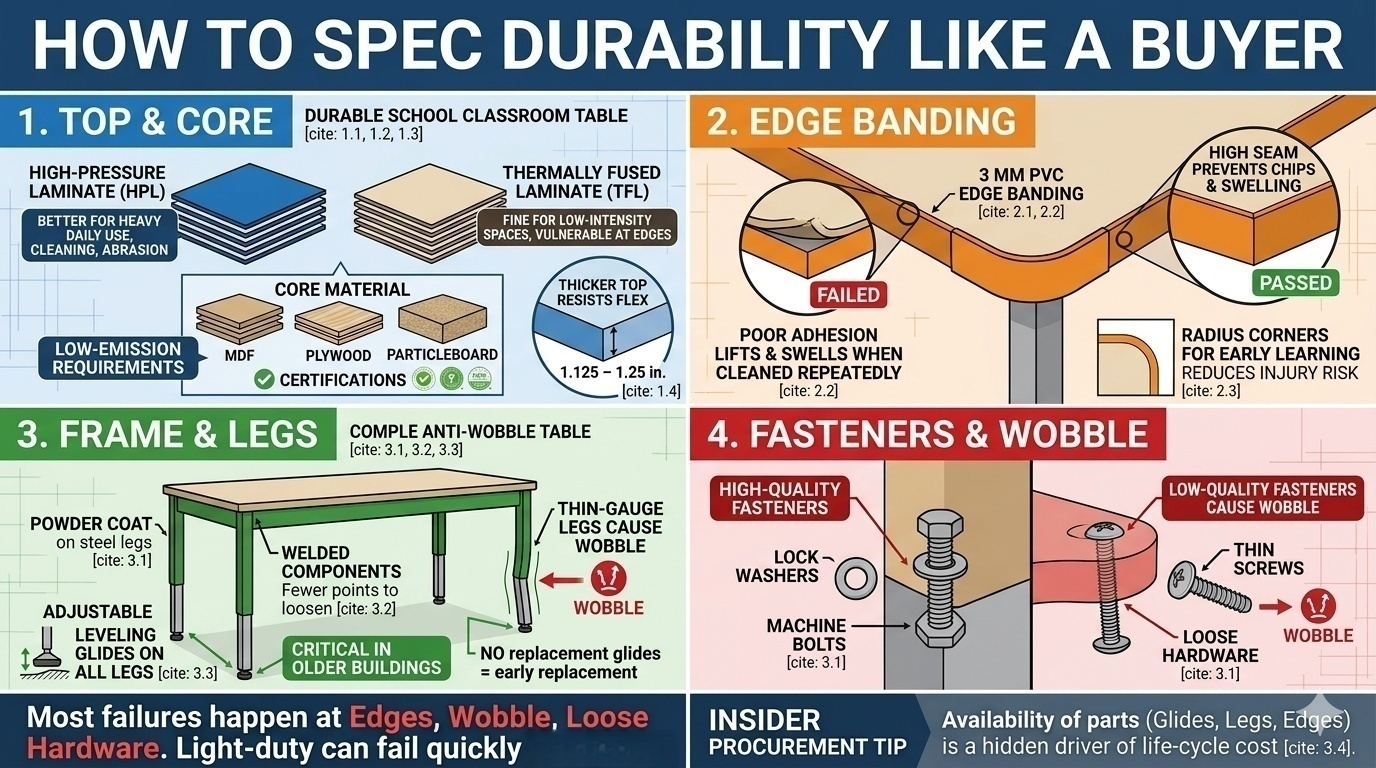
High-pressure laminate (HPL): better for heavy daily use, cleaning chemicals, and abrasion. Recommended for elementary classroom tables and high-traffic intervention rooms.
Thermally fused laminate (TFL): typically less costly; fine for low-intensity spaces but more vulnerable at edges and corners.
Core material: ask whether it’s particleboard, MDF, or plywood and whether it meets low-emission requirements (see certifications below).
Spec detail that matters: a thicker top generally resists flex and feels more stable. Many districts standardize around 1.125–1.25 in. thick tops for student tables and classroom group tables in higher-use rooms.
Edge failures are the number-one reason tables get pulled early. Prioritize:
3 mm PVC edge banding (or comparable) for impact resistance, especially in elementary tables.
Seam quality: poorly adhered edges lift and then swell when cleaned repeatedly.
Radius corners in early learning (reduces injury risk and edge damage).
Wobble usually comes from thin-gauge legs, insufficient cross-bracing, or low-quality fasteners. For long-term performance, look for:
Steel legs with powder coat (better than paint in a high-cleaning environment).
Welded frame components where possible (fewer points that loosen).
Adjustable leveling glides on all fixed-leg tables (critical in older buildings with uneven slabs).
Insider procurement tip: If the vendor won't provide replacement glides, legs, or edge components as spare parts, expect the district to replace tables sooner than planned. Availability of parts is a hidden driver of life-cycle cost.
Depending on district policy, you may need to verify one or more of the following:
Low VOC / indoor air quality: GREENGUARD Gold (common in K–12 specs).
Composite wood emissions: CARB Phase 2 / TSCA Title VI compliance (relevant when tops use composite cores).
Structural performance standards: some manufacturers test to furniture durability standards used in education/contract environments. Ask for test data, not marketing claims.
Classroom tables with storage can reduce clutter and improve transitions, but only if the storage matches the workflow. The wrong storage turns into knee-banging hardware or blocked wheelchair clearance.
Under-table tote trays: excellent for preschool classroom tables and K–2 where supplies rotate daily.
Book box / shelf: good for student table use in 3–5 where students manage binders and novels.
Locking teacher storage: appropriate on a teacher table when it holds assessments, IEP folders, or devices.

Knee clearance: storage components can reduce legroom and make tables uncomfortable for older students.
Cleaning access: complex racks catch paper scraps and require more custodial time.
Weight + mobility: storage adds weight; if the room needs frequent reconfiguration, a lighter base may outperform built-in storage.
In device-rich classrooms, cable management is a safety spec, not a convenience feature. The typical failure mode is extension cords across traffic paths, especially when group layouts change mid-day.
For classroom tables for high school (and increasingly 4–6), consider:
Centralized charging zones (a dedicated counter or charging cart) to reduce power requirements at every table.
Integrated wire channels under tops for tables that do need power.
Grommet placement that matches real device use (laptops at table edges, not only at center).
Protected cord routing so cords don't hang where backpacks catch them.
Field note: If you're installing floor boxes, coordinate table layouts early. A table plan that shifts even 12–18 inches can turn a floor box into a trip hazard or leave it stranded under a seam where it's unusable.

Even the best classroom furniture tables fail if circulation is tight. When the teacher pulls a small group, the rest of the class still needs to move—turn in work, access materials, and transition without bottlenecks.
Keep the teacher table within a quick scan line to the rest of the room (avoid corners that force the teacher’s back to independent learners).
Protect an unobstructed path from door to key zones (teacher table, sinks, storage, exits).
Plan for adult circulation: teachers need to slide in/out repeatedly without moving chairs.
Accessibility requirements vary by jurisdiction and project scope, but from a practical standpoint, you need at least some accessible student tables for classrooms with adequate knee clearance and reachable surfaces. Don't rely on a last-minute “we'll swap in one table” fix—height, leg placement, and under-table obstructions matter.

Below are practical spec priorities by grade band, including what tends to break, what teachers request after move-in, and which table types hold up best.
Priorities: rounded corners, easy-clean surfaces, stable footprint (kids climb).
Best fits: small kids school table units, crescent teacher tables for centers, and lightweight group tables for quick resets.
Common miss: sharp edge profiles and tops that stain from constant wet cleaning.
Priorities: correct height, impact-resistant edging, shapes that support guided reading.
Best fits: kidney teacher table + mixed student tables (rectangles + trapezoids) to create stations.
Common miss: oversized teacher table depths that reduce reach and slow instruction.
Priorities: reconfigurable layouts, strong frames, surfaces that tolerate science activities.
Best fits: classroom group tables with leveling glides, plus one or two small-group tables with a clear sightline to the room.
Common miss: “pretty” finishes that scratch quickly under daily tool use (scissors, rulers, compasses).
Priorities: power strategy, durability, and flexible collaboration.
Best fits: modular high school tables (trapezoid/rectangle) that can form pods; classroom work tables for maker/STEM; and skinny tables where square footage is tight.
Common miss: ignoring cord routing and ending up with unsafe power strips and broken ports.
Table type Best use What to watch Where it wins Kidney/crescent teacher table Guided reading, interventions, assessment Depth too large reduces reach; needs stable frame Fast, high-touch instruction in K–5 U-shape Speech/OT, direct instruction, supervised writing Footprint; chair pull-out clearance Maximum visibility of hands/work Rectangular student tables Capacity, testing flexibility, budget control Leg placement can block knees; edge durability Easy to standardize across a district Trapezoid / modular group tables STEM, collaboration, reconfigurable pods Needs strong connectors/frames to avoid wobble Real project work and frequent room resets Classroom tables with storage Daily supplies, centers, student organization Knee clearance, cleaning access, added weight Reduces clutter; speeds transitions

Confirm grade-band heights (and whether rooms may be reassigned).
Choose the right shape for instruction: kidney for small group, modular for collaboration, rectangles for capacity.
Demand durability details: top thickness, laminate type, edge band thickness, frame construction, and whether leveling glides are included.
Verify indoor air quality and emissions compliance if required by the district.
Plan power intentionally for device-heavy rooms; avoid “cord sprawl” assumptions.
Check storage against accessibility (knee clearance and under-table obstructions).
Standardize finishes and SKUs to simplify future replacements and match lots across phases.
Ask about replacement parts and warranty (glides, legs, edge components) to reduce total cost of ownership.
Request lead times and substitution rules early—education table lines can shift seasonally.
“Cheap” classroom tables often become expensive when they fail early. A more reliable approach is to compare total cost of ownership:
Expected service life: Will the edge banding survive daily cleaning? Will frames loosen after constant movement?
Maintenance burden: Can custodial staff clean quickly without special products?
Parts availability: Can the district replace glides/legs instead of scrapping the entire school table?
Standardization: Fewer models mean faster, cheaper replenishment for damaged student tables.
If you're sourcing classroom tables for sale through multiple vendors, require apples-to-apples submittals that list laminate type, core, edge band, frame material, and warranty. That's the only way to compare a “classroom tables cheap” bid to a higher-cost bid that may last twice as long.
When you want predictable performance, give bidders clear minimums. Examples you can adapt:
Teacher table for classroom (K–5): kidney shape; HPL top; thick impact-resistant edge; steel frame; leveling glides; optional lockable storage.
Elementary classroom tables (student use): rectangular/trapezoid mix; HPL or durable laminate; radius corners; heavy-duty legs; glides for uneven floors.
High school tables: modular rectangles/trapezoids; cable management strategy; durable top; strong frame for frequent reconfiguration; optional modesty panels for device-heavy pods.
The right teacher table decision isn't about a single product—it's about matching shape, height, durability, and layout to the way instruction actually happens. When you spec with those realities in mind, classroom tables stop being a punch-list problem and become a reliable foundation for the room's daily work.


 English

