
Views: 0 Author: Site Editor Publish Time: 2025-08-19 Origin: Site


EF Education First's unprecedented $2.1 billion commitment to upgrading its global network of language learning centers underscores the growing importance of cultural integration and adaptive learning spaces in modern education.

By combining rich, multi-lingual signage with state-of-the-art adjustable furniture, EF is redefining how students engage with new languages and cultures. This article explores four pillars of this transformation:
1. Strategic Use of Multi-Lingual Signage
2. Designing Adaptive Classroom Layouts
3. Integrating Culturally Inclusive Décor
4. Procuring Adaptive Education Furniture
We then examine five real-world examples of EF centers, present key comparison tables, and conclude with actionable recommendations. A six-question FAQ will address common concerns about implementing similar solutions.
An environment rich in diverse languages primes learners for immersion from the moment they enter a center. EF's signage strategy goes beyond translation: it creates a seamless learning ecosystem.
Key Elements of EF's Signage Strategy
Layered Language Displays: Primary messages in the target language, secondary prompts in students'native tongues.
Dynamic Digital Panels: AI-driven rotation of vocabulary and cultural facts.
Wayfinding Icons: Universal pictograms paired with multi-lingual labels to ease campus navigation.
Table 1: Comparison of Signage Modalities
| Signage Type | Content Mode | Customization Level | Annual Maintenance Cost | Student Engagement Impact |
Static Printed Signs | Fixed Text/Images | Low | $500 | Moderate |
Digital LED Panels | Rotating Text/Video | High | $2,000 | High |
Interactive Kiosks | Touch-Based Learning | Very High | $3,500 | Very High |
1. Cognitive Reinforcement: Simultaneous exposure to multiple languages cements new vocabulary.
2. Cultural Contextualization: Rotating facts about festivals, history, and cuisine foster global understanding.
3. Wayfinding Efficiency: Students of all backgrounds navigate facilities without confusion.
EF's classrooms shift seamlessly between lecture, conversation circles, and independent study—all triggered by scheduling software and occupancy sensors.

Modular Zones: Movable partitions create micro-environments for small-group language labs.
Conversation Circles: Circular seating fosters eye contact and encourages verbal practice.
Focus Pods: Semi-private booths equipped with noise-cancellation for one-on-one tutoring.
Table 2: Layout Configuration Comparison
| Layout Model | Primary Function | Reconfiguration Time | Technology Integration |
Open Forum | Large Seminars | 5 minutes | Overhead microphones |
Circle Conversation | Group Dialogue | 2 minutes | Central digital whiteboard |
Silent Study Pods | Individual Work | Instant via sliding panels | Personal audio stations |
Automated Scheduling: Class type and student profiles inform the overnight layout change.
Utilization Analytics: Heat maps of room usage guide furniture reallocation.
Personalized Acoustics: AI-driven sound dampening adjusts panel tension for optimal noise control.
Beyond signage and layout, EF invests in cultural artifacts, artwork, and local student projects to deepen cross-cultural ties.
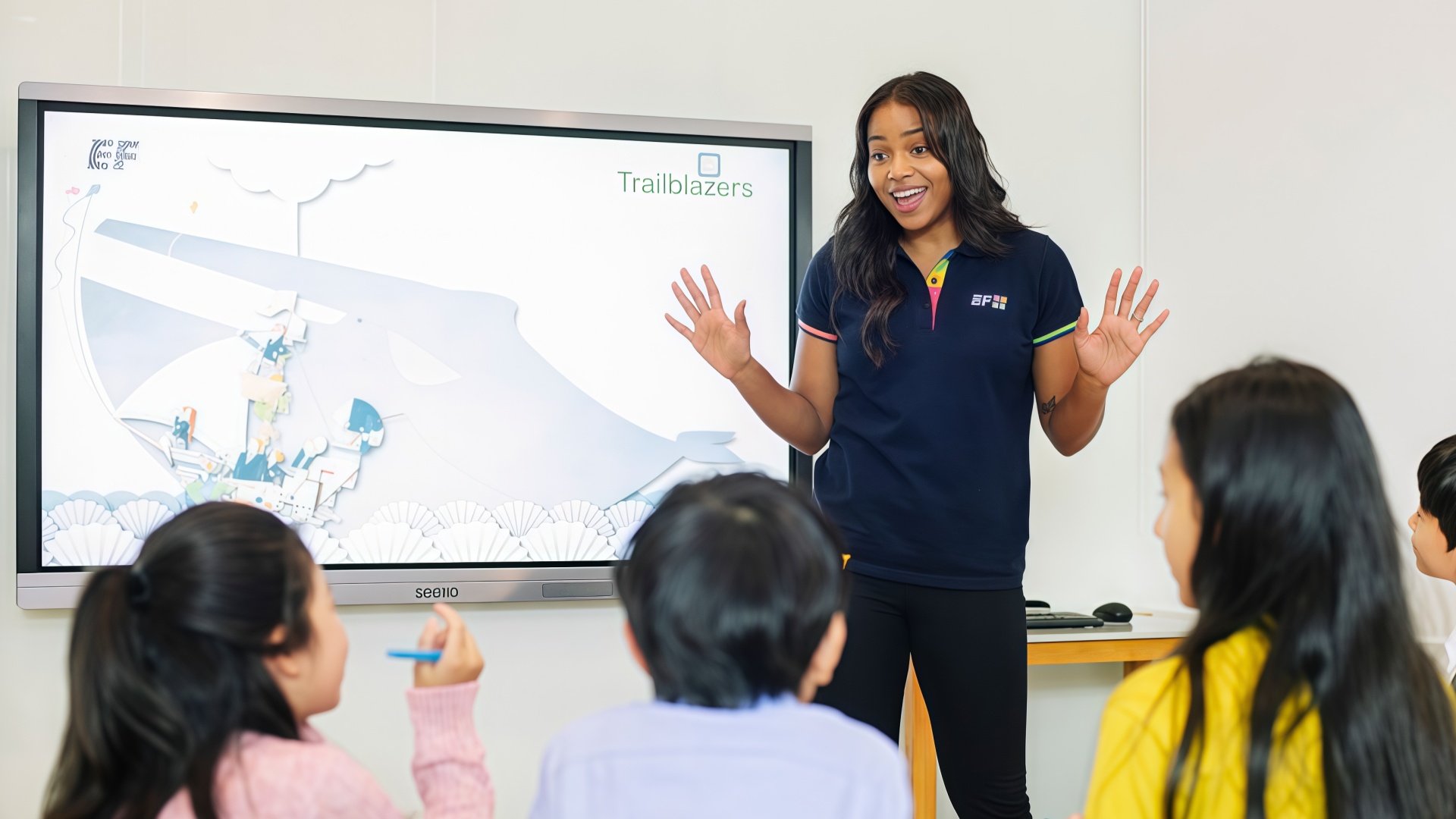
Décor Components
Rotating Art Exhibitions: Student-curated displays celebrating home-country artists.
Global Library Corners: Shelves organized by region, featuring bilingual book labels.
Interactive World Maps: Touch-sensitive walls that display regional language facts on demand.
Table 3: Décor Feature Comparison
| Feature | Cultural Emphasis | Interactive Level | Installation Cost | Maintenance Effort |
Static Murals | High | Low | $4,000 | Low |
Digital Art Frames | Medium | Medium | $6,000 | Medium |
Touch-Sensitive Maps | Very High | Very High | $8,500 | High |
Impact on Student Experience
Emotional Connection: Seeing familiar cultural symbols reduces anxiety in language immersion.
Peer Collaboration: Students contribute to rotating exhibits, fostering community.
Contextual Learning: Touch-activated maps link geography with language exercises.
A critical component of EF's upgrade is adaptive education furniture that supports mixed-use learning scenarios and accommodates diverse body types.
Height-Adjustable Smart Desks: Motorized desks that recall user profiles for height and angle.
Posture-Monitoring Chairs: Embedded sensors gently prompt students to adjust posture.
Mobile Whiteboard Tables: Lightweight tables with writable surfaces and built-in digital capture.
Stackable Flexible Seating: Easy storage and rapid deployment for pop-up conversation circles.
Table 4: Smart Furniture Feature Matrix
| Furniture Item | Smart Features | Price Range | Durability Rating | Ideal Use Case |
Motorized Smart Desk | Profile recall, USB ports | $900–$1,300 | 8/10 | Individual learning + tests |
Posture Chair | Haptic posture alerts | $300–$450 | 7/10 | Extended lecture sessions |
Whiteboard Mobile Table | Digital capture, wheels | $400–$600 | 9/10 | Group brainstorming |
Stackable Modular Stool | Lightweight, nesting design | $50–$80 | 6/10 | Pop-up conversations |
Total Cost Analysis: Balance initial purchase price against expected lifespan and maintenance.
Usage Analytics: Furniture that reports usage patterns can optimize future investments.
Vendor Collaboration: Co-design opportunities with manufacturers yield tailored solutions.
1. EF London Central introduced multilingual digital wayfinding, boosting first-day orientation efficiency by 40%.
2. EF Seoul Language Hub uses height-adjustable desks to accommodate a 60% increase in student diversity.
3. EF São Paulo Immersion Center features rotating Brazilian and Portuguese art exhibits, enhancing cultural pride.
4. EF Tokyo Conversation Studio installed mobile whiteboard tables, increasing group activity time by 30%.
5. EF Dubai Global Academy implemented AI-triggered layout shifts, reducing manual setup time by 75%.
EF Education First's $2.1 billion investment in language learning center design—through multilingual signage, adaptive classroom layouts, culturally inclusive décor, and adaptive education furniture—exemplifies the future of immersive language education. Schools aiming to replicate this success should prioritize scalable infrastructure, flexible furnishings, and strategic vendor partnerships to deliver truly engaging, culturally resonant learning spaces.
Q1: How do I choose the right multilingual signage for my center?
Assess your student demographics and incorporate layered translations with dynamic digital panels to maximize engagement and comprehension.
Q2: What's the most cost-effective way to implement adaptive layouts?
Start with modular partitions and mobile furniture; then integrate AI scheduling tools as budgets allow to automate reconfiguration.
Q3: How can cultural décor improve language acquisition?
Culturally familiar artifacts lower affective filters, making learners more open to practicing new vocabulary and grammar in context.
Q4: Are smart desks worth the investment?
Yes. Height-adjustable desks and profile recall save setup time, enhance ergonomics, and deliver personalized learning experiences that boost outcomes.
Q5: How do I measure ROI on adaptive furniture?
Track usage analytics, student performance metrics, and space utilization rates before and after installation to quantify benefits.
Q6: Can small centers adopt these strategies on limited budgets?
Absolutely. Prioritize low-cost items like stackable seating and printed multilingual signage, then expand to digital and AI solutions as funding grows.


 English

